16 years one-stop China custom CNC machining parts factory

Hey there I’m VMT Sam!
With 25 years of CNC machining experience we are committed to helping clients overcome 10000 complex part-processing challenges all to contribute to a better life through intelligent manufacturing. Contact us now
 1 |
Published by VMT at Nov 21 2026 | Reading Time:About 6 minutes


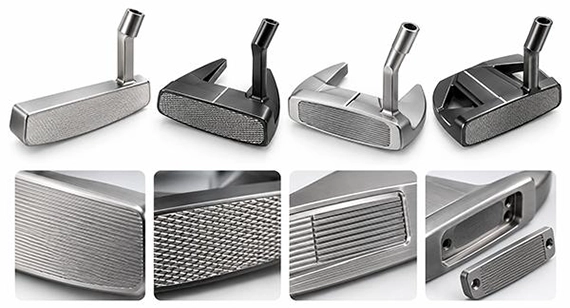
From the crisp acoustic feedback at impact to the moment of inertia (MOI) and toe hang that determine putting stability, the superior performance of custom CNC machined golf putter heads is essentially the result of the coordinated interaction between head geometry, metals with different properties, and micron-level precision machining processes.
This guide takes a dual perspective on engineering design and supply chain sourcing to provide a comprehensive analysis of the design principles behind six mainstream putter head styles, the acoustic and weighting characteristics of key metal materials, and the differences between CNC machining and casting. It also breaks down three essential quality criteria for evaluating reliable CNC machining suppliers, helping you transform complex putter designs into high-end, market-competitive products with greater precision and efficiency.
At the end of this guide, we will also present a case study demonstrating how precision CNC machining resolved weight variation in 300 multi-material putter heads, reducing weight deviation from ±4.5g to within ±0.8g, while addressing toe hang consistency issues to ensure that all assembled putters met the customer's face-balanced requirements.
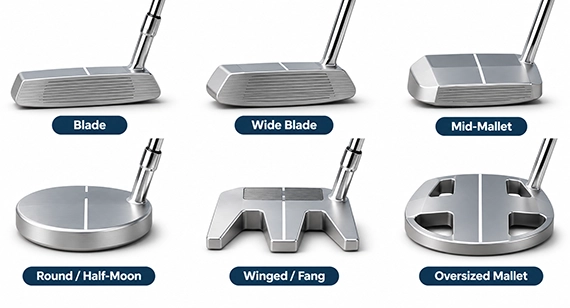
Different putter head shapes influence alignment, forgiveness, weight distribution, and overall appearance.
When designing golf putter head products, you first need to understand the common putter head styles available on the market and their target users:
1. Blade Putter Heads
Featuring a compact, elongated traditional design, blade putters are suitable for traditional golfers who prefer a classic appearance, responsive feedback, and greater distance control. They are particularly popular among low-handicap golfers with an arcing putting stroke.
2. Wide Blade Putter Heads
Building on the traditional blade design, wide blade putters feature a wider head and additional mass distribution toward the rear. They are suitable for golfers who want to retain the blade-style appearance while gaining greater forgiveness and more consistent putting performance. During the design process, you can moderately widen the rear flange and adjust the weight distribution.
3. Mid-Mallet Putter Heads
Combining characteristics of blade putters and large mallet putters, mid-mallet designs are suitable for golfers who want more prominent alignment aids and a more stable swing weight without preferring an oversized head shape. Design options include adding top alignment lines, rear extensions, or localized weighting features.
4. Round and Half-Moon Mallet Putter Heads
Their rounded, symmetrical profiles provide considerable design flexibility. These putters are suitable for golfers who prefer a softer appearance, clear alignment aids, and a stable feel at impact.
5. Winged and Fang-Style Mallet Putter Heads
By extending two wings or fang-shaped structures toward the rear, these designs create a wider visual profile and provide golfers with more prominent directional references. They are suitable for golfers who prioritize alignment assistance, forgiveness, and consistent straight-back putting performance.
6. Oversized Mallet Putter Heads
Featuring larger head volumes and more space for weight distribution, oversized mallet putters are suitable for golfers who prioritize putting stability, forgiveness, and intuitive alignment assistance, including some mid- to high-handicap players. During the design process, MOI can be increased by enlarging the head, adding perimeter weighting, or incorporating tungsten alloy weights.
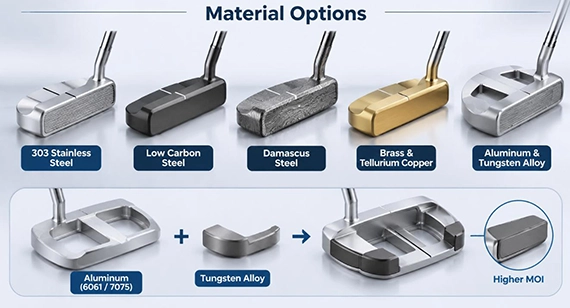
Material selection not only determines the machining difficulty and cost of CNC golf putter heads but also affects impact sound, feel, corrosion resistance, and weight distribution. When selecting materials, you should consider the impact feedback preferences of golfers in your target market, the putter head structure, and the required weight distribution.
303 Stainless Steel: Suitable for premium putter designs that prioritize classic metallic impact feedback and corrosion resistance. Its good machinability makes it easier to CNC machine intricate contours, alignment lines, and face details. With good corrosion resistance, it generally requires no additional rust-prevention coating, making it a common choice for one-piece precision-machined putter heads.
Low Carbon Steel (1018/1020 Carbon Steel): Suitable for traditional golfers who prefer a softer, solid feel at impact and is commonly used in custom putters designed to emphasize a soft feel. However, low carbon steel is prone to rust and typically requires protective surface treatments such as Black Oxide, PVD, or other coatings to improve corrosion resistance.
Damascus Steel: Primarily targeted at the luxury custom and collector-grade putter markets. Its layered patterns create a distinctive visual appearance. The material is typically forged first to form its composite patterns, followed by CNC finish machining and acid etching to highlight the grain. This process places relatively high demands on material processing and surface finishing.
Brass and Tellurium Copper: These materials have relatively high densities and offer different weight distribution characteristics and softer impact sounds compared with stainless steel. They are commonly used for face inserts, localized weighting, or vintage-style putter designs. Tellurium copper, in particular, offers good machinability, making it suitable for precision-machined inserts. However, surface oxidation and discoloration need to be considered.
Aluminum (6061 / 7075 Aluminum) and Tungsten Alloy: These are commonly used together in modern multi-material, high-MOI putter designs. Aluminum alloys have relatively low density and are suitable for machining large mallet head bodies. By reducing weight in the central area, they create more room for perimeter weighting. Tungsten alloy has a density of approximately 17–19 g/cm³ and can be incorporated into the rear or sides of the putter head to concentrate more mass around the perimeter, thereby increasing moment of inertia (MOI) and improving stability on off-center hits.
CNC Golf Putter Head Materials: Recommendation Table
| Material | Target Market / Users | Product Characteristics | Preferred Feel and Performance |
| 303 Stainless Steel | Mid- to high-end markets, professional and traditional golfers | Good corrosion resistance and machinability, suitable for one-piece precision machining | Prefer solid, crisp metallic impact feedback |
| 1018 / 1020 Carbon Steel | Premium custom market, traditional feel enthusiasts | Good machinability but prone to rust, requiring protective surface treatments | Prefer a softer, solid feel at impact |
| Damascus Steel | Luxury custom and collector-grade markets | Unique layered patterns, distinctive appearance, demanding machining and surface finishing requirements | Prefer distinctive aesthetics and personalized designs |
| Brass / Tellurium Copper | Vintage putter enthusiasts, premium custom market | Relatively high density, suitable for face inserts and localized weighting | Prefer softer, more subdued impact sounds |
| 6061/ 7075 Aluminum + Tungsten | Modern performance-oriented golfers, mid- to high-end mallet market | Lightweight aluminum body combined with high-density tungsten weights, allowing MOI optimization | Prefer greater forgiveness, stability, and more flexibility in weight distribution |
For golf putter heads that require precise control over weight, face geometry, and weight distribution, CNC machining offers greater control than casting. This is particularly advantageous for new product development, small-batch production, and premium custom projects, making CNC machining the preferred choice in these situations.
Table: CNC Machining vs. Casting Golf Putter Heads
| Comparison Criteria | CNC Machining | Casting |
| Internal Quality | Machined from solid billets, eliminating the risk of casting porosity and shrinkage cavities and ensuring material integrity. | May contain pores and internal voids, affecting localized material quality and impact feedback. |
| Weight Consistency | Weight variation can be controlled to approximately ±0.5–1g. | Weight variation is typically around ±3–7g. |
| Cost | No mold is required. Prototyping typically takes approximately 1–2 weeks, making it suitable for custom and small-batch production. | Tooling costs at least several thousand US dollars per set, with a development lead time of approximately 6–8 weeks. |
| Machining Precision & Details | Allows precise machining of the putter face, edge chamfers, and fine alignment lines. | Detail quality is limited by mold precision and typically requires subsequent CNC finish machining. |
Why Are CNC Machined Putter Heads Better Suited to Premium Custom Designs?
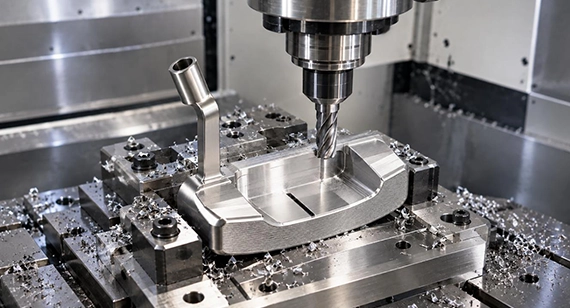
For premium custom golf putter heads, the manufacturing method directly affects weight distribution, center-of-gravity positioning, and impact feedback.
CNC machining allows direct control over the machining dimensions of the face, hosel, rear flange, and weighting structures (with tolerances as tight as ±0.005mm achievable in some applications). It also allows the amount of material removed from different areas to be adjusted according to design requirements, enabling more precise weight control. Compared with casting, which relies on mold-based forming, CNC machining offers greater flexibility for design iterations, complex geometries, and small-batch customization.
Of course, casting does not necessarily mean lower quality. For mid-range putter heads with mature designs, large order volumes, and cost-sensitive requirements (such as putters intended for beginners), casting still offers advantages in production efficiency and unit cost. However, in such cases, customization may not be necessary, as standardized putter heads can already meet these requirements at a lower price.
Therefore, overall, unless your golf equipment brand is targeting the large-volume mid-range market, CNC machining remains the better choice.
Pitfall 1: Angular and Concentricity Deviations in the Hosel Bore
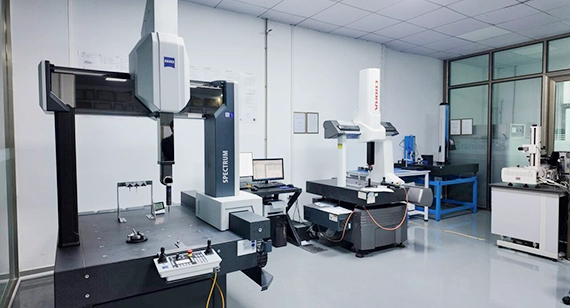
The machining angle and position of the hosel bore affect the putter's lie angle (typically around 70°) and loft angle (typically around 2°–4°). Poor control over hole position, machining angles, or assembly fit tolerances can cause the actual putter setup to deviate from the design requirements, affecting the golfer's alignment and putting direction. When evaluating suppliers, pay particular attention to whether they have dedicated multi-axis positioning fixtures and use coordinate measuring machines (CMM) to inspect the position, orientation, and actual angles of the hosel bore——quality inspection.
Pitfall 2: Machining Accuracy of Weight Ports and Insert Pockets
Overly loose thread fits in adjustable weight ports, or deep tool marks and uneven depths on the bottom surfaces of insert pockets, can affect the installation stability of weights and face inserts. Over time, these issues may also cause loosening and unwanted rattling. When evaluating suppliers, focus on their thread machining and bottom-surface finishing capabilities. For example, they should be able to use precision flat-end mills to machine insert pockets and control bottom-surface flatness within 0.005 mm (subject to drawing requirements and actual inspection results).
Pitfall 3: Misalignment Between Alignment Aids and Machining Datums
Top sightlines and sight dots play an important role in helping golfers achieve consistent alignment. If the workpiece is fixtured using only the raw billet edges as references, without considering the putter head's design centerline, face datum, and actual center-of-gravity position, the alignment features may not correspond to the intended impact center. This can negatively affect the visual alignment experience. When evaluating suppliers, confirm whether they establish consistent machining datums and inspect the positional relationships between the alignment features, putter face, head center, and design center of gravity before and after machining.
——Case Study from VMT CNC Machining Factory
Background
An independent premium putter brand (Boutique Studio) in North America planned to launch a limited edition of 300 winged mallet putters featuring a multi-material design. The putter heads used a 6061-T6 aluminum alloy body combined with two tungsten alloy rear wings to balance lightweight construction with perimeter weighting requirements.
Problem
The putter heads machined by the previous supplier had weight variations of up to ±4.5g. This resulted in toe hang deviations of more than 8° between different putter heads after shaft assembly, making it difficult to maintain consistent weight distribution and putter fitting specifications across the entire batch. As a result, the products failed to meet the customer's performance requirements for premium golf equipment.
Engineering Solutions:
We first weighed and sorted the 6061-T6 aluminum alloy and tungsten alloy billets by batch to minimize the effects of variations in raw material density and weight.
We then carried out five-axis CNC machining in a temperature-controlled workshop, standardizing tool paths and machining allowances to reduce the impact of temperature fluctuations and machining errors on finished product weight.
Meanwhile, during the machining of the weight pockets, we used Renishaw in-machine probes for workpiece positioning and dimensional measurement. Based on the actual measurement results, we dynamically compensated for machining depth to ensure consistent installation positions and weight distribution for both tungsten alloy rear wings.
Final Results
Following process optimization, the finished net weight tolerance of all 300 putter heads was controlled within ±0.8g. After assembly, all units met the customer's face-balanced requirements, significantly improving fitting consistency across the production batch. After the first batch of 300 products entered the market, end-user feedback on their performance and feel was positive, and the customer subsequently placed repeat orders.
As golf consumers increasingly demand personalized products, the future of premium putter head design and manufacturing is moving beyond traditional machining of single-metal materials. Instead, the industry is accelerating toward multi-material composite structures (such as lightweight aerospace aluminum bodies combined with high-density tungsten alloy weights), advanced high-MOI forgiveness designs, and personalized custom face milling patterns. Meanwhile, the rise of boutique golf brands and limited-edition golf equipment is creating new market growth opportunities centered on small-batch production, rapid design iterations, and premium pricing.
Are you ready to turn your CNC golf putter head designs into precision-machined components with consistent quality?
Don't let minor machining tolerances, weight distribution deviations, or hosel bore angular errors compromise your carefully developed putter designs. Whether you are currently tackling toe hang consistency issues in multi-material putter heads, looking for CNC machining solutions for 303 stainless steel or low carbon steel putter heads with high-quality surface finishes, or planning a small-batch trial production run of 50–500 units without incurring expensive tooling costs, VMT CNC Machining Factory can provide engineering-level support.
Upload your 3D CAD drawings (IGS/STP/STEP files) and 2D drawings (PDF files), and we will provide the following within 24 hours:
Send your 2D drawings, 3D CAD models, putter head style, material, target head weight, hosel configuration, face milling requirements, insert or weight-pocket design, surface finish, prototype quantity and production quantity. VMT will review DFM, machining strategy, weight consistency, critical fits, datum relationships, finishing and quotation requirements.
All information and uploaded files are secure and confidential.
1 Tell us what you need
2 Get solution & quote
3 Approve production
Email: inquiry@vimetal.com.cn
1. What surface finishes are available for custom CNC putter heads?
Common surface finishes include Satin Brush, Bead Blast, PVD vacuum coating, and Cerakote ceramic coating. These processes can create refined metallic textures, low-reflectivity matte finishes, black or rainbow-colored appearances, and wear-resistant protection, respectively. In addition, Paint Fill can be used to customize brand logos, alignment lines, and decorative details.
2. How important is ±0.005mm tolerance for a custom milled putter head?
A machining tolerance of ±0.005mm is particularly important for critical features of custom CNC machined golf putter heads, such as insert pocket depth and gap clearance between multi-material components. It helps achieve a flush fit, preventing assembly gaps and potential vibration or rattling noises.
3. How do you prevent thread galling in stainless steel weight ports?
This issue commonly occurs in 303 stainless steel golf putter heads. Repeated installation and removal of weight screws can cause galling in 303 stainless steel. Our CNC machining factory typically uses thread milling to control thread accuracy and fit clearance, combined with anti-seize coatings or lubrication measures to reduce the risk of thread seizure and wear.
4. What is putter face milling, and why does it matter?
Face milling involves using CNC milling machines and different tool paths to create specific textures, grooves, or flat surfaces on the putter's striking face. Different milling depths, spacing, and surface patterns change the contact conditions between the ball and the putter face, thereby affecting impact sound, feel, and surface appearance.
5. How does face milling affect putter feel and ball roll?
Deep face milling creates relatively deep surface textures. The deeper tool marks reduce the actual contact area between the putter face and the ball, generally producing a softer feel and a relatively lower-pitched impact sound. Micro-groove or flat milling, on the other hand, creates a very flat putter face with the largest contact area between the face and the ball. This allows more direct energy transfer, producing a crisp, high-frequency impact sound (click) and giving golfers a more solid, clear, and direct (crisp and firm) feel.
6. Do hosel configurations affect toe hang and putting stroke?
Yes. Different hosel configurations affect the relationship between the shaft axis and the putter head's center of gravity, thereby changing the toe hang angle and compatibility with different putting strokes. Common configurations include Plumber's Neck, Flow Neck, Slant Neck, Center Shaft, and welded hosels.
The technical information and manufacturing advice shared on the machining-custom.com website are for general guidance only. While we strive for accuracy, machining-custom.com does not guarantee that the processes, tolerances, or material properties mentioned are applicable to every specific project. Any reliance you place on such information is strictly at your own risk. It is the buyer's responsibility to provide definitive engineering specifications for any production orders. Final specifications and service terms shall be subject to the formal contract or quotation confirmed by both parties.


 +86 15099911516




 Read more