16 years one-stop China custom CNC machining parts factory

Hey there I’m VMT Sam!
With 25 years of CNC machining experience we are committed to helping clients overcome 10000 complex part-processing challenges all to contribute to a better life through intelligent manufacturing. Contact us now
 0 |
Published by VMT at Nov 21 2026 | Reading Time:About 8 minutes


1.Introduction
When scaling up the production of custom CNC-machined inline speed skate frames, your team needs to strike a balance between structural performance and manufacturing costs. Machining frames from solid aluminum billets offers high structural strength and design flexibility, but the cost per unit can be relatively high. Conventional high-pressure die casting, on the other hand, offers lower unit costs but may fall short of the material performance and fatigue resistance required for professional speed skating.
One solution that balances manufacturing costs with structural performance is a hybrid process combining custom aluminum extrusion with secondary CNC machining. By first developing a custom extrusion die to produce aluminum profiles with an integrated U-shaped cross-section and reinforcing ribs, then using multi-axis CNC machining to finish mounting surfaces and cutout structures, manufacturers can reduce production costs by 25%–50% compared with machining frames entirely from solid aluminum billets. Actual savings depend on product geometry and production volume, while still meeting the stiffness and fatigue resistance requirements of professional competition.
In the final section, we will also share a real manufacturing case study in which our factory reduced production costs by 33% for a customer's order of 1,500 pairs of custom inline speed skate frames using aluminum extrusion combined with CNC machining.
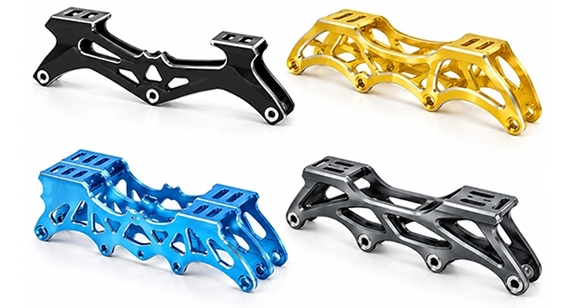
Inline speed skating equipment requires a low center of gravity, lateral torsional resistance, and lightweight construction. Although many standard, off-the-shelf frames are available on the market, custom frame design offers significant advantages if you want to develop products with differentiated performance and appearance.
The following mainstream specifications and configurations can serve as a reference when developing your own custom inline speed skate frames. They can help you determine suitable wheel configurations and structural design directions based on your target users, competition environments, and product positioning.
Common Inline Speed Skate Frame Configurations and Specifications
Wheel configurations:
Boot mounting distance and deck height:
Adult speed skate frames typically use a 195mm two-point mounting standard, while youth models and certain other types of inline skates use a 165mm mounting standard. When developing custom frames, you can also incorporate elongated adjustment slots (Slotted Mounts) into the mounting platforms, allowing skaters to adjust the frame's front-to-back position and lateral offset to suit their individual stance and skating preferences.
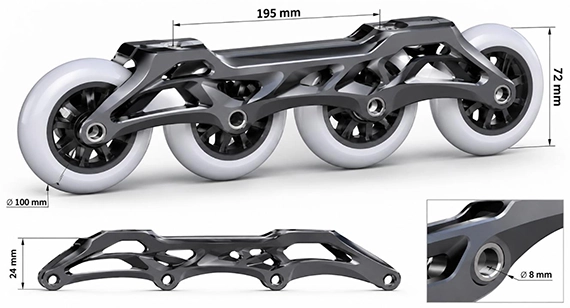
Why Consider Custom Speed Skate Frame Design?
1. Adjusting Stiffness and Toughness to Meet Performance Requirements
The bridge structure of standard, off-the-shelf frames is generally fixed. Custom frame design, however, allows your engineering team to adjust the thickness, position, and angle of the intermediate support ribs. This helps maintain longitudinal support while optimizing structural stiffness and toughness under lateral loads during cross-over movements in corners, improving overall skating stability and handling.
2. Balancing Lightweight Construction with Product Appearance
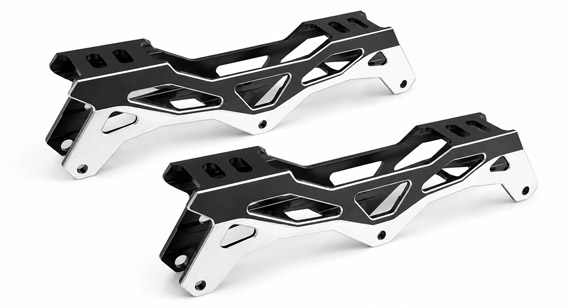
Through structural features such as truss-style cutouts and chamfered side wings, you can reduce material consumption while maintaining the necessary structural strength. Some designs can target a single-frame weight of 190g–230g. Meanwhile, distinctive structural contours and design details help establish a recognizable visual identity for your product.
3. Optimizing Deck Height
By customizing the boot contact surface, axle positions, and mounting clearance for the first and last wheels, you can further optimize the overall frame height. While maintaining sufficient clearance for normal wheel rotation, the frame can be designed to position the boot as close to the wheels as possible. This lowers the skater's center of gravity and improves stability and handling at high speeds.
There are three main manufacturing approaches for inline speed skate frames: machining from solid aluminum billets, aluminum extrusion alone, and aluminum extrusion combined with secondary CNC machining. These processes differ significantly in how parts are formed, their manufacturing workflows, and their suitable applications.
Comparison of Three Main Manufacturing Processes
| Comparison | Full CNC Machining | Aluminum Extrusion Only | Aluminum Extrusion + Secondary CNC Machining |
| Base material | Solid aluminum billet | Aluminum extrusion billet | Aluminum extrusion billet |
| Forming method | The complete frame is machined directly from solid aluminum | Formed through a custom extrusion die | Extruded first, followed by precision CNC machining |
| Structural design | Flexible, allowing complex geometries | Primarily limited by the extrusion die cross-section | Combines an optimized main cross-section with complex local features |
| Machining accuracy | Critical dimensions can be controlled through CNC machining | Primarily depends on the extrusion die and subsequent processing | Critical dimensions are controlled through secondary CNC machining |
| Material utilization | Generally involves substantial material removal | High material utilization | Reduces material removal compared with full CNC machining |
| Main characteristics | Suitable for complex designs and small-batch production | Suitable for mass production with fixed cross-sectional geometries | Combines efficient batch forming with precision machining capabilities |
Step-by-Step Manufacturing Process: Aluminum Extrusion + CNC Machining
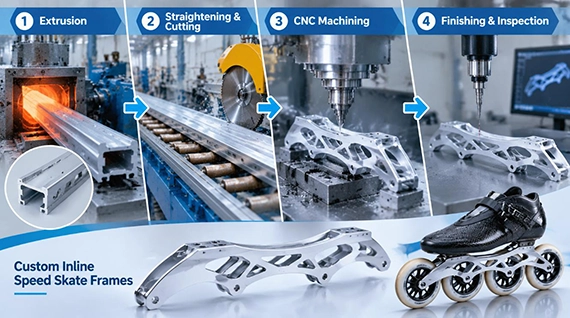
1. Custom Aluminum Profile Extrusion
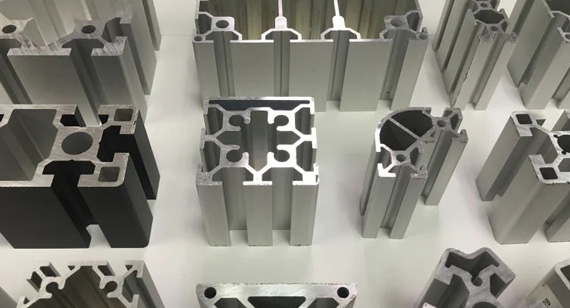
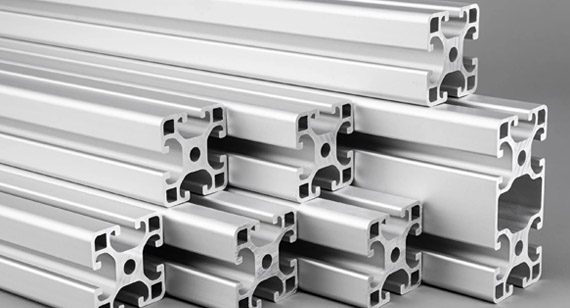
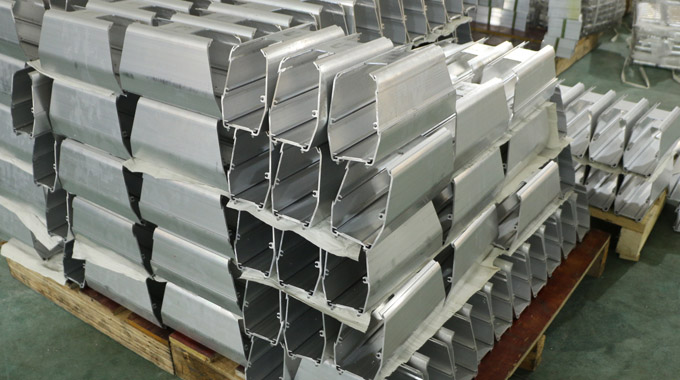
Preheated aluminum alloy billets are pushed through a dedicated extrusion die to form continuous profiles featuring a U-shaped cross-section, two sidewalls, and connecting ribs. This provides the basic structural foundation of the skate frame.
2. Profile Processing and Cutting
After extrusion, the profiles undergo cooling, stretching and straightening, and any necessary heat treatment, such as achieving the T6 temper. They are then cut into individual blanks according to the required frame dimensions.
3. Precision CNC Machining
The individual blanks are transferred to 3-axis, 4-axis, or 5-axis CNC machining centers. Operations include machining axle holes, boot mounting slots, sidewall cutouts, and other features that require precise dimensional control.
4. Aluminum Surface Finishing and Inspection
Depending on product requirements, post-processing operations such as deburring, sandblasting, and anodizing are performed. Critical dimensions and assembly positions are then inspected.
Why Choose This Hybrid Manufacturing Process?
The core principle is to let aluminum extrusion handle the initial forming of the frame's main structure, while CNC machining handles complex geometries and precision-critical features.
Compared with machining an entire frame from a solid aluminum billet, this approach reduces material removal and certain CNC machining operations while preserving the structural design flexibility required for the finished product.
Different aluminum and magnesium alloys have varying properties in terms of strength, toughness, machinability, and formability. When developing inline speed skate frames, you should select the appropriate material and manufacturing route according to your product positioning and performance requirements, rather than relying solely on material prices or machining costs.
Comparison of Common Materials and Manufacturing Processes
| Alloy | Positioning and Key Properties | Suitability for Die Casting | Recommended Manufacturing Process | Suitable Applications |
| 7075-T6 Aluminum | High-strength aluminum alloy with a yield strength of approximately 500 MPa and an excellent strength-to-weight ratio | Not suitable for conventional high-pressure die casting | Full CNC machining from solid billets | High-performance competition, custom professional racing frames, and small-batch products |
| 6061-T6 Aluminum | Good overall mechanical properties, combining strength, toughness, and machinability | Not a conventional die-casting material | Aluminum profile extrusion + secondary CNC precision machining | Mid- to high-end speed skate frames and mainstream mass-production models |
| ADC12 / A380 | Good casting characteristics, suitable for complex geometries in mass production, although mechanical properties and fatigue performance must be evaluated based on the specific alloy and process | Suitable for high-pressure die casting | High-pressure die casting + localized CNC machining | Entry-level, recreational, and certain non-high-load applications |
| Magnesium Alloy (AZ91D) | Low density and good lightweight potential, but requires greater attention to corrosion protection and surface finishing | Suitable for die casting | Magnesium alloy die casting + precision CNC machining + corrosion-resistant surface treatment | Specialized custom products where weight is a critical consideration |
Key Manufacturing Considerations for Different Materials
It is important to note that material performance depends not only on the alloy designation but also on the heat treatment condition, forming process, and part geometry. Final material selection should be based on actual loading conditions and product testing results.
Why Is 6061-t6 Aluminum Extrusion More Suitable for Inline Speed Skate Frames Than Other Materials?
Aluminum alloys are well suited to extrusion manufacturing for inline speed skate frames because they offer a favorable balance of weight, strength, machinability, and manufacturing cost. Taking 6061 aluminum as an example, it offers good extrusion formability and mechanical properties, allowing manufacturers to use custom dies to produce profiles with U-shaped cross-sections, sidewalls, and reinforcing ribs. Subsequent CNC machining is then used to finish critical features such as axle holes and mounting slots.
It is worth noting that not all commonly used aluminum extrusion alloys are suitable for high-performance speed skate frames. For example, 6063 aluminum offers excellent extrusion characteristics, good surface quality, and superior anodizing results. These properties make it widely used in architectural applications such as window and door frames, curtain walls, and decorative profiles. However, its mechanical properties in commonly used tempers are generally lower than those of 6061, making it more suitable for applications involving moderate stress levels. For inline speed skate frames that must withstand repeated dynamic loads, lateral impacts, and torsional forces during cornering, 6061-T6 is generally a more suitable choice.
Steel, by comparison, offers higher strength but also has a much greater density, and conventional profile extrusion is not the mainstream cost-effective manufacturing route for this type of frame. Magnesium alloys are lighter, but extrusion formability, machining safety, and corrosion-resistant surface finishing involve additional requirements that must be carefully evaluated. Plastics, meanwhile, generally struggle to meet the stiffness and structural stability requirements of high-performance speed skate frames.
Therefore, aluminum is not the only available material. However, for inline speed skate frames that need to balance lightweight construction, structural rigidity, and mass-production costs, 6061-T6 aluminum extrusion combined with secondary CNC machining is a solution worth prioritizing during the manufacturing evaluation process.
The choice of manufacturing process depends not only on the material and structural design but also on your order quantity. The proportion of costs associated with tooling investment, material utilization, CNC machining time, and post-processing changes as production volumes increase.
The following analysis outlines recommended manufacturing solutions for different production volumes of inline speed skate frames. Actual cost proportions will vary depending on product dimensions, structural complexity, material prices, and supplier production efficiency.
Stage 1: Small-Batch Prototyping and Production (1–500 Units)
Recommended Process: Full CNC Machining from Solid Aluminum Billets
Stage 2: Medium-Volume Production Scaling (500–2,000 Units)
Recommended Process: Aluminum Extrusion + Secondary CNC Machining
Stage 3: Large-Scale Mass Production (Over 2,000 Units)
Depending on your product positioning and performance requirements, two different manufacturing routes can be considered.
Route A: Professional Competition Products (6061-T6)
Route B: Entry-Level Mass-Market Products (ADC12 / A380)
It is important to note that although die casting offers cost advantages in large-volume production, it cannot directly replace the aluminum extrusion + CNC machining process used for professional speed skate frames. The two approaches differ in material properties, structural design capabilities, and fatigue life, so they should be evaluated separately according to product positioning.
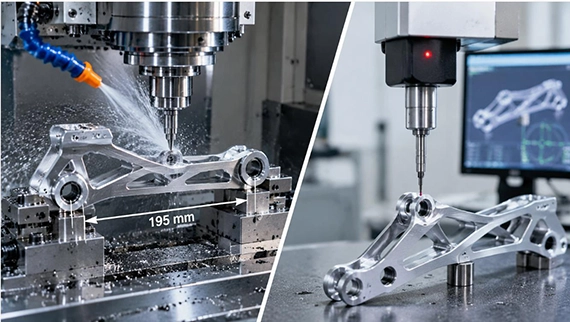
Inline speed skate frames require not only sound structural design but also precise control over critical assembly dimensions and surface quality. In particular, axle mounting positions, wheel spacing, and boot contact surfaces all influence wheel operation and overall skating stability.
Three Critical Precision Machining Areas (Primarily Controlled Through CNC Machining)
1. Axle Hole Concentricity and Bore Tolerance
2. Frame Inner Width
3. Boot Mounting Flatness
Surface Roughness and Fatigue Resistance
Surface Finishing Requirements:
For mid- to high-end anodized frames, visible surfaces can be specified with a surface roughness of Ra 1.6–Ra 3.2, depending on design requirements. Bead blasting can improve surface texture and reduce the visibility of certain machining marks before anodizing and coloring.
Structural Safety and Fatigue Life:
Inline speed skate frames experience repeatedly changing loads during skating and cornering. Rough machining marks, sharp edges, and surface defects may create stress concentration points, increasing the risk of fatigue crack initiation.
Therefore, critical load-bearing areas should receive proper CNC finishing, deburring, and any necessary surface treatment. Fatigue testing should also be conducted under representative loading conditions.
It is important to emphasize that the dimensional tolerances and surface roughness values above are reference engineering targets, not universal standards for all inline speed skate frames. Actual tolerances should be established according to wheel specifications, bearing configurations, boot mounting systems, and product operating requirements.
——Case Study From VMT CNC Machining Factory
Background
A European sports brand was developing a new 4x110mm adult speed skate frame with a target weight of 205g per frame. Initially, the client used full CNC machining from solid 6061-T6 aluminum plates to produce 200 pairs for trial production.
When the client prepared to increase its annual procurement volume to 1,500 pairs, excessive raw material waste and long machining times pushed production costs more than 30% above the target budget.
Analysis and Solution
After our engineering team conducted a Design for Manufacturability (DFM) analysis, we revised the manufacturing process to custom 6061-T6 aluminum extrusion + secondary 4-axis CNC precision machining.
By developing a custom extrusion die to directly form U-shaped blanks with dual bridge reinforcing ribs, we reduced the material removal rate per unit from 76% to just 28%.
The extrusion process also preserved the continuous metal structure along the profile's extrusion direction, while integrating certain structural features that would otherwise have required CNC machining directly into the extruded cross-section. This reduced subsequent material removal and the number of machining operations.
For secondary precision machining, we designed dedicated multi-station pneumatic fixtures that allowed the sidewall weight-reduction cutouts, 195mm mounting slots, and four sets of axle holes to undergo precision boring and tapping in a single setup.
This not only eliminated accumulated errors caused by repeated workholding but also maintained the concentricity of paired axle holes within 0.035mm. At the same time, the CNC machine cycle time per unit was reduced by nearly half.
Results
Ultimately, with a relatively low investment in extrusion tooling, the project achieved a 33% reduction in total manufacturing cost per pair compared with the full CNC machining approach.
After full-surface bead blasting and hard anodizing, the frames successfully passed high-intensity fatigue testing, helping the client complete the initial mass-market product launch on schedule.
Choosing the right materials and manufacturing processes is critical to balancing competitive performance with commercial profitability in custom aluminum inline speed skate frame projects.
For projects requiring rapid validation of high-stiffness competition prototypes, full CNC machining from 7075-T6 aluminum billets is a viable option. However, for production orders ranging from several hundred to several thousand pairs, combining 6061-T6 aluminum extrusion with secondary CNC machining offers the potential to reduce manufacturing costs by 25%–50%.
Matching materials with the right manufacturing processes during the early design stage can therefore help minimize subsequent trial and error while keeping project costs under control.
Are you facing challenges such as excessively high full CNC machining quotes, uncertainty about extrusion cross-section design, or difficulties maintaining axle hole concentricity and anodized surface finish quality?
Contact our engineering team and upload your 3D CAD drawings (IGS/STP/STEP files) and 2D Drawings (PDF files). Based on your target wheel configuration and initial order quantity, we will provide a Design for Manufacturability (DFM) assessment, extrusion cross-section optimization recommendations, and quotations for different production volumes within 24 hours.
Send your 2D drawings, 3D CAD models, wheel configuration, mounting standard, target material, target weight, annual volume, surface finish, tolerance requirements and current production method. VMT will review extrusion feasibility, CNC machining strategy, fixture requirements, critical axle-hole relationships, anodizing allowances and cost-reduction opportunities.
All information and uploaded files are secure and confidential.
1 Tell us what you need
2 Get solution & quote
3 Approve production
Email: inquiry@vimetal.com.cn
1. How long does it typically take to develop an extrusion die and dedicated CNC fixtures?
Manufacturing and trial testing of custom aluminum extrusion dies typically takes just 7–12 calendar days, significantly faster than developing die-casting molds. With secondary CNC machining fixtures developed simultaneously, the process from 3D drawing approval to delivery of the first batch of samples can generally be completed within 3–4 weeks.
2. Can the same aluminum extrusion die be used for frames with different wheel diameters or lengths?
If two frame models share the same cross-sectional width, wall thickness, and height distribution, but differ only in overall length or sidewall cutout patterns, they can generally share the same extrusion die. The extruded profiles simply need to be cut to different lengths, with the corresponding machining programs selected during the secondary CNC stage. This helps brands further distribute tooling investment across multiple product models.
3. Are integrated single-sided aluminum threaded holes on frame sidewalls prone to thread stripping?
Inline speed skate frames often use fine-pitch threads, such as M7×0.75, tapped directly into one sidewall to secure the axle bolts. As long as properly specified T6-tempered 6061 or 7075 aluminum alloy is used, and CNC tapping is performed with form taps (Form Tapping) or precision thread mills to maintain the required pitch diameter tolerance and effective thread engagement, the threads can meet the pull-out resistance and tightening torque requirements associated with repeated wheel installation and removal.
4. What wear-resistant methods can be used to apply brand logos to frames after anodizing?
The most common approach is precision laser engraving after anodizing. This produces clear lettering without compromising the main structural integrity of the frame. For premium custom models, shallow embossed lettering can also be machined directly into the sidewalls during the CNC stage. Alternatively, a secondary anodizing process can be used to create durable, two-tone metallic branding.
5. How do manufacturers quickly inspect axle hole concentricity and frame inner width during mass production?
In addition to first-article inspection and periodic sampling using Coordinate Measuring Machines (CMM) to generate comprehensive dimensional reports, mass-production lines are typically equipped with custom Go/No-Go Gauges and extended precision check mandrels. Quality inspectors can check axle insertion smoothness and gauge fit to complete a full assembly interchangeability inspection of each frame within seconds.
6. What if we only have a hand-drawn concept or physical sample and no existing extrusion cross-section drawings?
You only need to provide a 3D model or physical sample of the finished inline speed skate frame. Our manufacturing engineers can assist with reverse engineering and cross-sectional analysis, helping determine which features should be incorporated into the extruded blank and which should be left for secondary CNC machining with appropriate finishing allowances. We will then prepare complete aluminum extrusion profile drawings for your review and approval.
The technical information and manufacturing advice shared on the machining-custom.com website are for general guidance only. While we strive for accuracy, machining-custom.com does not guarantee that the processes, tolerances, or material properties mentioned are applicable to every specific project. Any reliance you place on such information is strictly at your own risk. It is the buyer's responsibility to provide definitive engineering specifications for any production orders. Final specifications and service terms shall be subject to the formal contract or quotation confirmed by both parties.


 +86 15099911516




 Read more