16 years one-stop China custom CNC machining parts factory

Hey there I’m VMT Sam!
With 25 years of CNC machining experience we are committed to helping clients overcome 10000 complex part-processing challenges all to contribute to a better life through intelligent manufacturing. Contact us now
 367 |
Published by VMT at Aug 24 2026 | Reading Time:About 6 minutes
367 |
Published by VMT at Aug 24 2026 | Reading Time:About 6 minutes


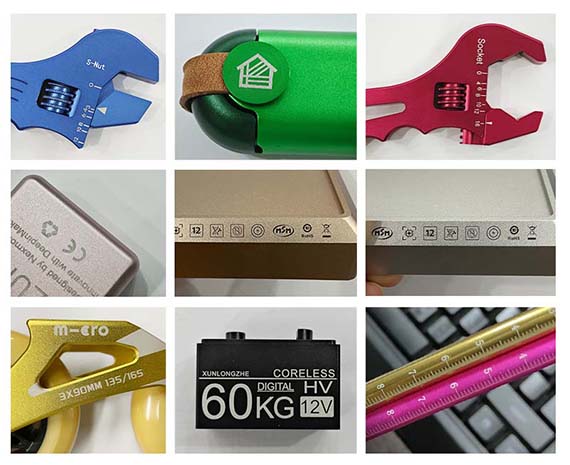
A logo, serial number, scale, or identification mark may look simple, but choosing the wrong engraving process can increase machining cost, reduce readability, damage a finished surface, or fail to provide enough depth for long-term wear. CNC engraving and laser engraving both create permanent marks, but they solve different manufacturing problems.
CNC engraving physically removes material with a cutting tool and typically produces deeper 0.1–0.3 mm recessed features, with greater depths available when required. Laser engraving is a non-contact process that can produce fine 0.01–0.02 mm marks with machining accuracy up to 0.02 mm on suitable parts. The better choice depends on depth, detail, material, finish, cost, and production volume.
If you are deciding how to add a logo or text to your CNC machined part, compare the required depth, detail, durability, surface finish, production quantity, and inspection requirements before selecting the process.
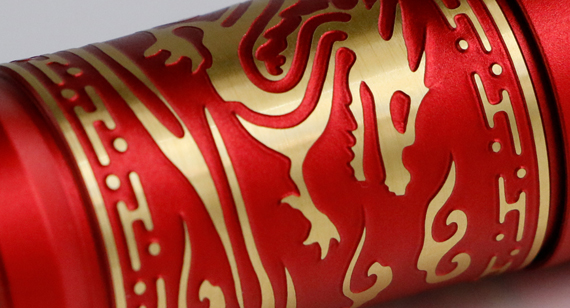
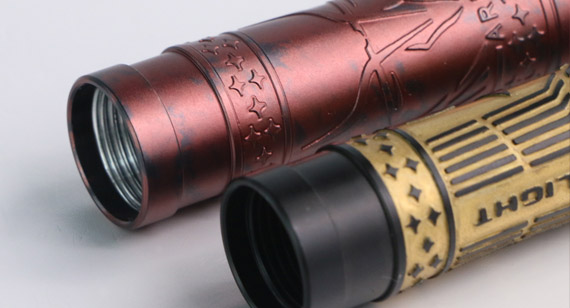
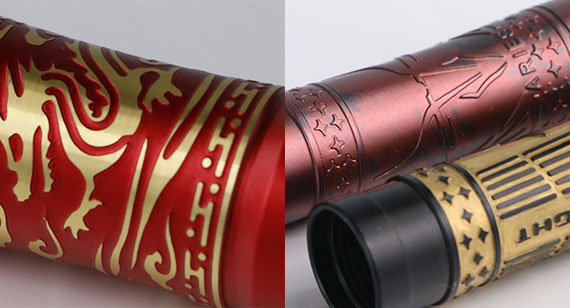
CNC engraving and laser engraving both create logos, text, numbers, symbols, and identification marks, but the way they remove or modify material is fundamentally different.
CNC Engraving
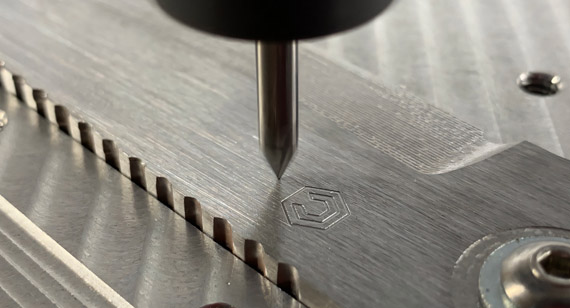
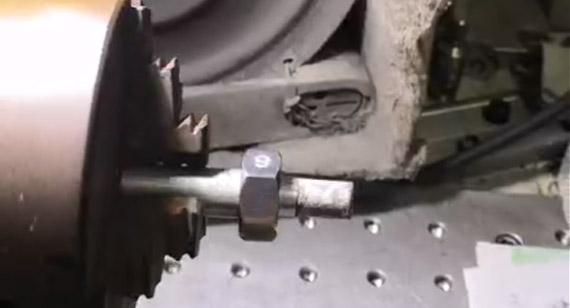
CNC engraving uses a rotating cutting tool to physically remove material from the part surface.
The tool follows a programmed path and creates a recessed groove with controlled width and depth.
It is commonly used for:
Because CNC engraving physically cuts into the material, it can create deeper markings and a clear recessed or tactile effect.
Laser Engraving
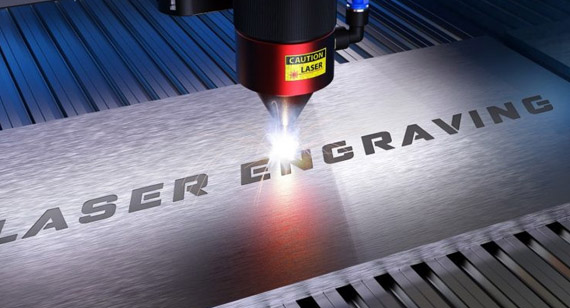
Laser engraving uses focused laser energy to remove or modify material without a cutting tool contacting the component.
For the CNC machined parts and logo applications covered by this guide, a typical VMT laser engraving depth is approximately 0.01–0.02 mm, depending on material, laser parameters, surface condition, and the required visual result.
Laser engraving is particularly useful for:
Laser engraving is non-contact, so there is no mechanical cutting force from an engraving cutter.
| Factor | CNC Engraving | Laser Engraving |
| Process | Rotating cutting tool removes material | Focused laser modifies or removes surface |
| Contact | Mechanical contact | Non-contact |
| Typical VMT depth | 0.1–0.3 mm | 0.01–0.02 mm for general logo marking |
| Greater depth | Can be machined according to requirements | Possible with process changes/multiple passes, but not normally the first choice for deep grooves |
| Fine detail | Good, limited by tool geometry | Excellent |
| Accuracy | Controlled by CNC machine, tool, fixture, and geometry | Up to 0.02 mm on suitable VMT projects |
| Laser spot | — | Generally below 0.5 mm for suitable marking setups |
| Cutting force | Yes | No mechanical cutting force |
| Tool wear | Cutter wears over time | No mechanical engraving cutter |
| Burr risk | Possible | No cutting burr from a mechanical cutter |
| Tool marks | Possible inside groove | No cutter marks |
| Deep tactile mark | Excellent | Less suitable for general shallow marking |
| QR / variable serial data | Possible but inefficient for frequent changes | Excellent |
| Anodized aluminum marking | Possible before finish | Very common after anodizing |
| Cycle time for small logos | Usually longer | Often faster |
| Relative cost for simple logos | Usually higher | Usually lower |
| Best use | Deep, durable or functional engraving | Fine, fast, detailed surface marking |
Neither method is universally better.
The correct process depends on what the mark must do after the CNC part enters service.
Depth is one of the clearest differences between the two processes.
How Deep Is Laser Engraving?
For general logos and identification marks on CNC machined parts, VMT can control laser engraving depth around 0.01–0.02 mm.
This shallow depth is useful when you need:
The laser removes or changes only a small surface region, so it can reproduce fine features without introducing mechanical cutting force.
What Controls Laser Engraving Depth?
Laser engraving depth is not determined by laser power alone
Important parameters include:
For deeper laser engraving, using several controlled passes can be preferable to applying excessive energy in one pass.
This helps control:
Laser systems can engrave deeper than a shallow marking layer, but when your drawing requires a clearly recessed 0.1–0.3 mm or deeper physical groove, CNC mechanical engraving is often the more direct process to evaluate. Laser-industry sources likewise distinguish laser's strength in precision/detail from mechanical engraving's advantage for deeper relief.
How Deep Is CNC Engraving?
For custom CNC machined parts, VMT commonly uses 0.1–0.3 mm engraving depth for logos, text, scales, and identification features.
However:
0.1–0.3 mm is not the maximum CNC engraving capability.
If your design requires additional depth, the engraving can be machined according to your drawing and application requirements.
The practical depth depends on:
Why Can CNC Engraving Go Deeper?
CNC machining controls depth directly through the programmed toolpath.
The cutter physically removes material from the component.
For deeper engraving, VMT can use:
This creates a physical recessed groove rather than only modifying the top surface layer.
For extremely fine text and small graphics, laser engraving usually has the advantage.
The reason is tool geometry.
CNC engraving requires a physical cutter to enter every stroke.
As characters become smaller:
Laser engraving does not require a rotating cutting tool to physically enter every feature.
For suitable VMT laser engraving projects:
These capabilities help produce small text and detailed logos when the material, surface, focus, fixture, and laser parameters are suitable.
How Is 0.02 mm Laser Engraving Accuracy Controlled?
Achieving fine laser engraving requires more than using a small beam.
The process depends on several controls.
Stable Part Positioning
A repeatable fixture controls where the logo is located relative to the CNC machined features.
Correct Focal Position
The laser needs to remain at the correct focus distance.
If the part surface is too high, too low, or curved beyond the controlled focus range, line quality can change.
Material-Specific Parameters
Aluminum, anodized aluminum, stainless steel, titanium, brass, and coated materials do not respond identically to laser energy.
Power, frequency, speed, and pass count are adjusted accordingly.
Surface-Finish Consistency
If anodized color, coating thickness, blasting texture, or polished appearance varies between parts, laser contrast may also vary.
First-Article Validation
For appearance-sensitive logos, the first completed part should be checked before batch production.
This confirms:
The 0.02 mm capability should therefore be understood as a controlled manufacturing capability for suitable projects rather than a number applied blindly to every material and geometry.
Both CNC and laser engraving can create permanent markings, but their durability comes from different mechanisms.
CNC Engraving Durability
CNC engraving creates a physical groove below the original surface.
This is particularly useful when the mark may experience:
Even if the top surface becomes worn, a sufficiently deep recessed feature can remain physically present.
Laser Engraving Durability
Laser engraving can also create a permanent mark.
Its long-term visibility depends on:
For serial numbers, QR codes, branding, and traceability, laser engraving can provide a durable solution without mechanical tool contact.
If your project specifically requires a deep tactile or wear-resistant groove, CNC engraving is normally the first process to evaluate.
This is one of the most common marking decisions for aluminum CNC parts.
CNC Engraving Before Anodizing
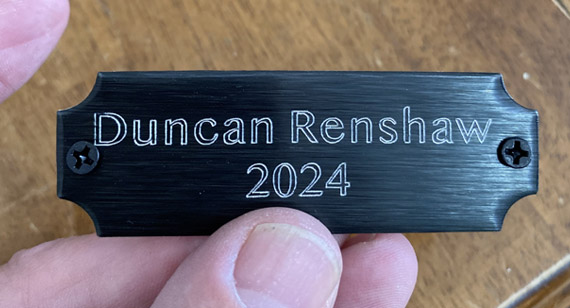
A typical manufacturing sequence is:
Because the recessed feature already exists before anodizing, the engraved area is anodized together with the surrounding aluminum.
This works well for:
Laser Engraving After Anodizing
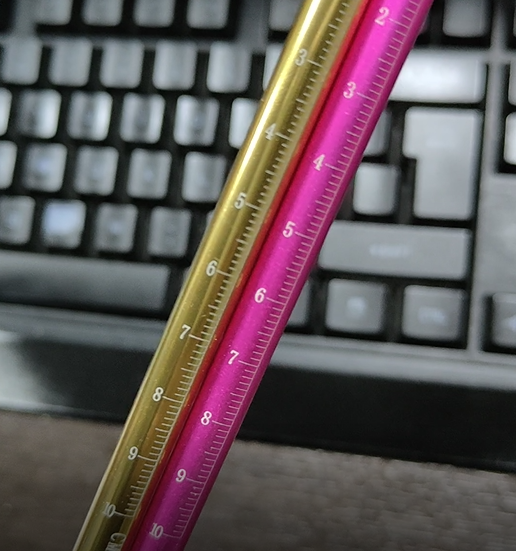
Laser engraving is often completed after anodizing when the customer wants a contrasting logo, serial number, QR code, or identification mark.
The laser can modify or remove part of the anodized surface to produce the required visual contrast.
It is well suited to:
Which One Should You Choose?
Choose according to the required result.
Need physical depth?
Consider CNC engraving.
Need a small contrasting mark after anodizing?
Consider laser engraving.
Need both?
The same CNC machined part can use both processes.
Aluminum
Both processes are widely used on aluminum.
CNC Engraving
Advantages:
Risks:
Laser Engraving
Advantages:
For aluminum consumer products and electronic housings, laser engraving after anodizing is particularly common.
Stainless Steel
CNC Engraving
Suitable when:
Challenges include:
Laser Engraving
Useful for:
Laser parameters must be controlled to achieve the required color, depth, and heat effect.
Brass and Copper
CNC engraving can produce clear recessed features in brass and copper alloys.
Laser engraving is also possible, but the final contrast depends on:
If visual appearance is important, prototype validation is recommended.
Titanium
Both CNC and laser methods can be used.
CNC engraving requires control of:
Laser engraving avoids mechanical cutting force and can be useful for detailed identification and traceability.
The correct process depends on required depth and appearance.
Engineering Plastics
Both methods may be possible, but material compatibility needs to be reviewed carefully.
CNC engraving can create controlled recessed grooves in plastics such as:
Laser marking behavior varies significantly between polymers.
CO₂ laser systems are commonly associated with many non-metal materials, while fiber laser systems are more relevant to many bare-metal marking applications. This distinction is important when selecting a laser process for CNC parts.
One important advantage of laser engraving is that the process is non-contact.
There is no mechanical cutter pressing against the part.
This can be useful for:
However, "non-contact" does not mean there are no process risks.
Laser engraving still introduces thermal energy.
If laser parameters are unsuitable, possible problems include:
CNC engraving has the opposite characteristics.
It introduces a physical cutting load, but the cutting depth can be controlled directly by the CNC toolpath.
In the original VMT process comparison, CNC mechanical engraving generally costs more than laser engraving for simple logo marking.
This manufacturing relationship is worth keeping because the two processes use machine time differently.
Why Is Laser Engraving Often Less Expensive for Simple Logos?
Laser engraving can be economical for small text and logos because:
For repeated logos or serial numbers, this can significantly reduce marking time.
Why Can CNC Engraving Cost More?
CNC engraving cost is affected by:
Deeper features also require more material removal.
If a small engraving cutter needs multiple passes, the cycle time increases further.
Is CNC Engraving Always More Expensive?
No.
If the engraving can be included efficiently in an existing CNC machining setup, the cost difference may become smaller.
The final cost depends on:
Therefore, cost should be evaluated together with the functional requirement.
Choosing a cheaper laser mark is not useful if your drawing actually requires a 0.3 mm deep tactile groove.
Laser engraving is generally faster for:
The laser follows a digital marking pattern without changing mechanical engraving tools.
CNC engraving is generally slower when:
However, CNC engraving can still be efficient when it is integrated into the main CNC machining program.
For parts requiring unique information on every component, laser engraving usually offers a major advantage.
Examples include:
These values can be changed digitally between parts.
With CNC mechanical engraving, each changing feature also needs to become part of the CNC toolpath.
It is possible, but usually less efficient.
For this reason, many CNC machined components use:
CNC machining for the component geometry + laser engraving for variable identification.
| Problem | Root Cause | Recommended Solution |
| Tool marks are visible | Physical cutter removes material | Select suitable cutter and cutting strategy |
| Burrs around text | Material behavior or tool wear | Sharp cutter, optimized toolpath and controlled deburring |
| Fine detail disappears | Cutter is too large | Adjust logo geometry or use a finer cutter |
| Small cutter breaks | Excessive tool load | Controlled depth passes and tool selection |
| Depth varies | Fixture or datum variation | Improve workholding and Z-reference control |
| Cost becomes high | Deep/complex toolpath | Review depth, logo complexity and setup |
| Internal corners become rounded | Physical cutter radius | Allow tool radius or optimize geometry |
Mechanical engraving inherently relies on a milling cutter physically removing material, which explains both its advantage in deep relief and its sensitivity to cutter geometry and tool wear.
| Problem | Root Cause | Recommended Solution |
| Weak logo contrast | Laser parameters do not match material/finish | Adjust power, speed, frequency and focus |
| Uneven mark | Surface or focus variation | Control part height and fixture |
| Heat discoloration | Excessive energy | Optimize power, speed and pass strategy |
| Mark position varies | Poor part positioning | Use repeatable fixture and datum |
| Anodized color reacts differently | Finish variation | Control anodizing and validate first article |
| Curved surface mark is inconsistent | Focus changes across surface | Review focus range and part orientation |
| Deep laser engraving is slow | Too many passes required | Evaluate CNC engraving instead |
Laser depth is influenced by power, pulse/frequency, speed, focus, pass count, and related process parameters rather than by power alone.
Choose CNC Engraving When You Need:
Choose Laser Engraving When You Need:
Use Both When the Part Has Different Requirements
You do not need to force every marking feature on a part into one process.
For example:
CNC engraving:
Functional position scale
Laser engraving:
Serial number and company logo
Combining processes can sometimes deliver better function, appearance, and cost control than selecting only one.
The engraving process should be selected before the complete manufacturing sequence is finalized.
Anodizing
Common options:
CNC engraving → anodizing
or:
anodizing → laser engraving
These produce different visual results.
Bead Blasting
Bead blasting changes surface texture and can influence both engraved appearance and laser contrast.
The process sequence should therefore be defined before production.
Powder Coating
A deep CNC groove can remain visible through a coating if the engraving geometry and coating thickness are coordinated.
Laser processing can also be used to modify or remove a finished coating when that appearance is required.
Plating
CNC engraving before plating may become visually softer as coating material builds on the surface.
Laser marking after plating may alter the plated layer.
Polishing
Mechanical polishing after CNC engraving can soften fine groove edges.
For cosmetic parts, the engraving and polishing sequence should be defined during DFM.
The marking method should be selected from the requirements on your drawing rather than from appearance alone.
During DFM review, VMT can evaluate:
When the Drawing Requires 0.1–0.3 mm or Deeper
CNC engraving is normally evaluated first because the cutter can physically machine the specified recessed depth.
For deeper requirements, VMT reviews:
When the Drawing Requires Fine Surface Marking
Laser engraving can be evaluated for the 0.01–0.02 mm general depth range, with suitable projects reaching 0.02 mm marking accuracy.
Control focuses on:
When Cost Is Important
If the mark is a small logo, serial number, or simple identification feature, laser engraving is often the more economical option.
If the mark must be physically deep, selecting laser solely because it is cheaper may result in a process that does not meet the functional requirement.
Project Background
A customer required a CNC machined aluminum control component with:
Project Challenge
The three marking features had different requirements.
The position scale needed a physical groove that could remain easy to locate and read during repeated use.
The company logo required fine visual detail.
The serial number changed on every component.
Trying to use one marking method for all three requirements would either increase machining cost or reduce production efficiency.
Root Cause Analysis
Functional Scale
Required physical depth.
Laser surface marking alone would not provide the same recessed geometry.
Fine Company Logo
Did not require a deep groove.
Using a very small CNC cutter would add unnecessary machining time.
Variable Serial Number
Each part required different information.
Changing the CNC engraving path for every component would be less efficient than digital laser marking.
VMT Solution
The manufacturing sequence used both processes.
CNC Engraving
The functional scale was CNC engraved as part of the machining process.
The cutter, groove geometry, depth, and datum relationship were reviewed before production.
Surface Finishing
The aluminum component then received the specified black anodized finish.
Laser Engraving
After anodizing, the company logo and changing serial number were laser engraved.
A dedicated positioning fixture controlled the relationship between the laser mark and the machined component.
Result
The combined process provided:
The case demonstrates why CNC engraving and laser engraving should be selected according to the function of each marking feature rather than assuming one process is always better.
The original VMT recommendation remains important:
Whenever possible, add your logo or text directly to the 3D CAD model.
This helps us understand the required size, location, orientation, geometry, and relationship to the CNC machined features.
3D CAD Model
Useful formats include:
The 3D model should show the logo geometry when the engraving forms part of the component.
2D Manufacturing Drawing
If the logo is not included in the 3D model, clearly define on the 2D drawing:
High-Resolution or Vector Logo File
Provide a separate logo file when required.
Vector formats are preferable for maintaining clean geometry.
Examples include:
If only a raster image is available, provide the highest-resolution original file.
For Laser Engraving, Also Specify:
For CNC Engraving, Also Specify:
Clear information at the quotation stage helps avoid rework later.
CNC engraving and laser engraving are not the only options.
Depending on the required appearance, CNC machined parts can also use:
These methods should not be selected only by appearance.
Color, wear resistance, material, surface finish, production volume, and cosmetic requirements all influence the final choice.
If you are comparing these additional logo methods, see our guide to laser engraving vs etching vs screen printing.
CNC engraving and laser engraving are complementary manufacturing processes rather than direct substitutes.
Choose CNC engraving when your design requires a physically recessed, deeper, tactile, or wear-resistant mark. For VMT projects, 0.1–0.3 mm is a common CNC engraving range, and greater depths can be machined according to suitable design requirements.
Choose laser engraving when you need fine logos, serial numbers, QR codes, variable data, fast processing, or marking after anodizing. For general VMT logo applications, 0.01–0.02 mm engraving depth, up to 0.02 mm marking accuracy, and a laser spot generally below 0.5 mm can be achieved on suitable projects through controlled focus, fixture positioning, laser parameters, and surface-condition management.
If your part requires both functional depth and fine identification, CNC engraving and laser engraving can also be combined.
Upload your 2D drawing, 3D CAD model, and logo file to VMT. Our engineers can review the required depth, detail, material, surface finish, machining sequence, marking position, production quantity, and inspection requirements and recommend the appropriate engraving process before prototype or mass production.
Send your 2D drawings, 3D CAD models, logo/vector file, material, required engraving depth, surface-finish requirements, marking details, prototype quantity and production quantity. VMT will review the marking method, depth, detail, process sequence, positioning, finishing requirements and manufacturing risks.
All information and uploaded files are secure and confidential.
1 Tell us what you need
2 Get solution & quote
3 Approve production
Email: inquiry@vimetal.com.cn
What Is the Main Difference Between CNC Engraving and Laser Engraving?
CNC engraving uses a physical cutting tool to remove material and create a recessed groove.
Laser engraving uses focused laser energy without a mechanical engraving cutter.
CNC engraving is usually better for deeper physical markings, while laser engraving is usually better for fine, fast surface identification.
What Is the Typical Laser Engraving Depth at VMT?
For general logo and identification applications on suitable CNC machined parts, VMT can achieve approximately 0.01–0.02 mm laser engraving depth.
The required result is controlled through laser parameters, focus, material, surface finish, and pass strategy.
What Is the Typical CNC Engraving Depth?
VMT commonly uses approximately 0.1–0.3 mm CNC engraving depth for logos and text.
This is not a maximum limitation.
If your drawing requires deeper engraving, VMT can evaluate cutter geometry, material, line width, wall thickness, and machining strategy and cut to the required depth when the design allows.
Can Laser Engraving Reach 0.02 mm Accuracy?
For suitable projects, VMT laser engraving accuracy can reach 0.02 mm.
Maintaining this level requires control of fixture positioning, focal distance, material, laser parameters, and surface condition.
How Small Is the Laser Spot?
For suitable VMT marking applications, the laser beam and spot can be generally below 0.5 mm.
The actual effective mark width depends on the laser system, focus, material, and process parameters.
Which Method Is Better for Small Text?
Laser engraving is generally better for extremely small text because it is not limited by a physical rotating cutter entering every character stroke.
CNC engraving can also machine small text, but tool size, stroke width, engraving depth, material, and cutter rigidity become increasingly important.
Which Is Better for Deep Engraving?
CNC engraving is normally better when your part requires a controlled, physically deep groove.
Typical VMT CNC engraving is approximately 0.1–0.3 mm, with greater depths possible according to the project.
Which Is Cheaper: CNC Engraving or Laser Engraving?
For many simple logos, serial numbers, and small identification marks, laser engraving is generally less expensive.
CNC engraving can cost more because of machine time, cutters, deeper material removal, additional toolpaths, deburring, and tool wear.
However, the final cost depends on the specific component and production process.
Which Method Is Better for Anodized Aluminum?
It depends on the appearance you need.
Use CNC engraving before anodizing when you want a physical recessed feature.
Use laser engraving after anodizing when you want fine, contrasting logos, serial numbers, or QR codes.
Can CNC Engraving and Laser Engraving Be Used on the Same Part?
Yes.
This is often the best solution when one feature needs physical depth while another requires fine detail or variable information.
For example, a functional scale can be CNC engraved while a serial number is laser engraved.
Does Laser Engraving Deform the Part?
Laser engraving is non-contact, so it does not introduce mechanical cutter force or mechanical extrusion into the part.
However, laser processing introduces heat.
Power, speed, frequency, focus, and pass count still need to be controlled, particularly on thin or cosmetic components.
Will CNC Engraving Leave Tool Marks?
CNC engraving physically removes material with a cutter, so machining marks can be visible inside the recessed groove.
The final appearance depends on:
What Should I Send to Get an Engraving Quote?
For the fastest DFM review and quotation, provide:


 +86 15099911516




 Read more