16 years one-stop China custom CNC machining parts factory

Hey there I’m VMT Sam!
With 25 years of CNC machining experience we are committed to helping clients overcome 10000 complex part-processing challenges all to contribute to a better life through intelligent manufacturing. Contact us now
 581 |
Published by VMT at Sep 23 2026 | Reading Time:About 5 minutes
581 |
Published by VMT at Sep 23 2026 | Reading Time:About 5 minutes


Choosing between galvanized and galvannealed steel comes down to these primary manufacturing decisions: paint adhesion, weldability, and outdoor corrosion exposure. While both start with a hot-dip zinc bath, galvannealed steel undergoes an inline annealing process to create a zinc-iron alloy coating (approx. 90% Zn, 10% Fe).
For your team designing sheet metal assemblies or custom CNC precision components, specifying the wrong coating leads to downstream production issues, such as paint flaking, welding electrode wear, or tool clogging during milling.
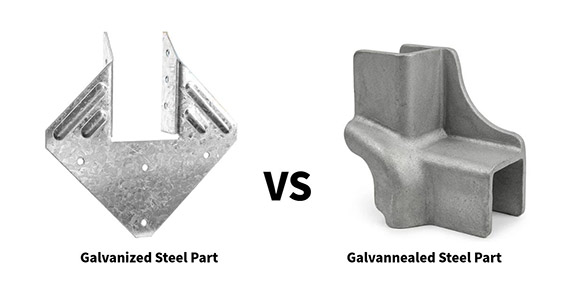
Key Differences at a Glance
Here is how the two coatings compare directly FOR a quick decision of the fabrication or machining project:
At the end of this article, we'll also share a real case study from our facility: how we advised a client to choose galvannealed steel instead of G90 galvanized for their outdoor communications enclosure that required painting, along with our precision machining and surface finishing process to prevent the risk of paint flaking off after a year.
Definition and Manufacturing Process
Galvanized steel typically refers to carbon steel coated with a protective pure zinc layer via hot-dip galvanization (HDG). Steel sheets or structural components are submerged in a molten zinc bath (around 450°C / 840°F), forming a metallurgically bonded, corrosion-resistant shield.
(Note: While electro-galvanizing / zinc electroplating also applies a zinc coating, it uses an electrochemical process to deposit a much thinner, spangle-free zinc layer. "Galvanized Steel" overwhelmingly refers to hot-dip galvanized stock.)
Common Industrial Standards (G90 vs. G60)
Hot-dip galvanized steel is specified by coating weight according to ASTM A653 standards:
Visual Appearance and Surface Spangle
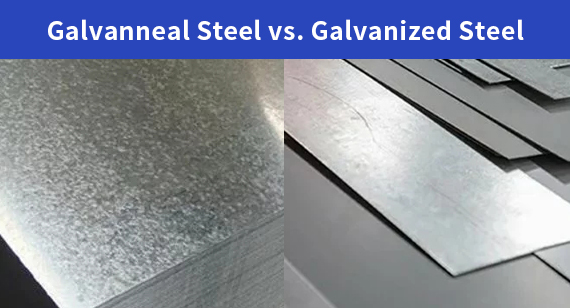
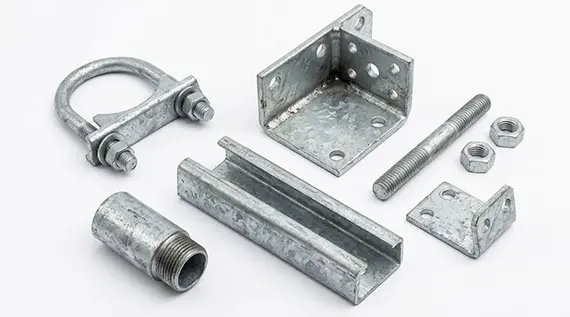
Hot-dip galvanized steel is easily recognized by its shiny, metallic appearance and distinct spangle patterns (crystalline zinc structures). Over time, atmospheric exposure forms a protective zinc carbonate patina, shifting the shiny look to a dull gray finish. The thickness of the zinc layer varies, with heavier coatings providing better durability.
What Is Galvanized Steel Used For?
Galvanized steel is ideal for unpainted, high-exposure outdoor applications where structural durability and low cost take priority over paint cosmetics or continuous welding efficiency:
What Are the Pros and Cons of Galvanized Steel?
Advantages
Galvanized steel remains a staple in industrial fabrication due to its exceptional cost-efficiency and long-term protective performance.
Disadvantages
While cost-effective, galvanized steel presents several manufacturing limitations in custom sheet metal and CNC fabrication:
Definition and Coating Process
Galvannealed steel is produced by taking hot-dip galvanized steel and immediately passing it through an inline heating furnace (annealing at approximately 500°C–550°C / 930°F–1020°F) while the zinc layer is still molten.
This thermal treatment causes iron from the steel substrate to diffuse into the zinc coating, forming a uniform zinc-iron alloy coating (typically ~90% Zn and 10% Fe).
Common Industrial Coating Standards (A60 vs. A40)
What Does Galvannealed Steel Look Like?
Matte Gray Appearance and Micro-Structure
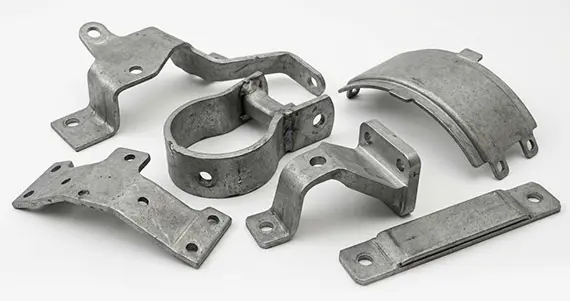
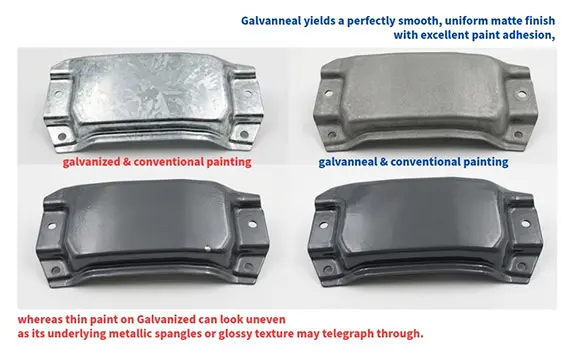
Unlike the shiny, reflective surface with visible spangles found on galvanized steel, galvannealed steel has a dull, matte gray, spangle-free finish.
Because the zinc has fully alloyed with the iron, there are no visible zinc crystallization patterns. Under microscopic inspection, the alloy surface exhibits a slightly porous, toothy texture. This micro-porosity acts as a natural anchor for liquid paints, e-coatings, and powder coatings.
What Is Galvannealed Steel Used For?
Galvannealed steel is the material of choice whenever a project requires corrosion protection combined with secondary painting, powder coating, or heavy spot welding:
Automotive Outer Body Panels: Doors, hoods, and fenders where high surface paint quality and automated spot-welding efficiency are mandatory.
Painted Outdoor Enclosures and Junction Boxes: Telecom cabinets, power distribution boxes, and industrial equipment shelters that may require powder coatings or custom paintings.
Architectural Hollow Metal Doors and Frames: Fire-rated metal doors, window casings, and security frames requiring smooth, durable painted finishes.
Household Appliance Components: Washing machine side panels, dryer housings, and commercial HVAC cabinets exposed to moisture and frequent handling.
Precision Sheet Metal and CNC Brackets: Custom machined, bent, or stamped brackets that undergo secondary spray finishing post-assembly.
Advantages
Galvannealed steel is engineered specifically to overcome the finishing and joining limitations of standard galvanized sheet.
Disadvantages
Despite its manufacturing benefits, galvannealed steel presents a few constraints that you can account for during design.
While both GI and GA steels originate from a hot-dip galvanizing process ( just the GA has the additional anealling step), their coating compositions and surface chemical structures are significantly different. These chemical differences affect their corrosion mechanisms, welding behavior, and coating adhesion.
1. Coating Chemical Composition
2. Chemical Behavior During Spot Welding
3. Surface Chemistry and Paint Bonding
Summary Table: Chemical and Coating Properties of Galvanized vs Galvannealed Steel
| Chemical Property | Galvanized Steel (GI) | Galvannealed Steel (GA) |
| Coating Chemical Composition | 100% Zinc (Zn) | Zinc-Iron Alloy (~90% Zn + 10% Fe) |
| Coating Structure | Smooth, non-porous metallic zinc | Micro-porous zinc-iron alloy |
| Standard Industry Specification | G30, G60, G90 (per ASTM A653) | A40, A60 (per ASTM A653) |
| Paint and Powder Coating Bonding | Poor (Requires chemical etching or primers) | Superior (Direct chemical/mechanical bonding) |
| Welding Reaction and Electrode Degradation | High zinc vaporization; rapid copper electrode wear | Controlled melting; extends electrode life by 2–3x |
| Unpainted Atmospheric Oxidation | Forms protective zinc carbonate barrier | Forms light iron oxide (flash rust) if unpainted |
While coating chemistry dictates corrosion mechanisms, physical and mechanical properties govern how these materials behave under structural loads, forming presses, and high-temperature environments.
1. Mechanical Strength and Substrate Properties
2. Surface Hardness and Scratch Resistance
3. Formability and Bending Behavior (Ductility vs. Coating Powdering)
4. Thermal and Heat Resistance
Summary Table: Physical and Mechanical Properties of GI vs GA
| Property | Galvanized Steel (GI) | Galvannealed Steel (GA) |
| Coating Surface Hardness | 30 – 50 HV (Soft, prone to scratches) | 150 – 200 HV (Hard, highly scuff-resistant) |
| Coating Bending Behavior | Highly ductile (Bends without flaking) | Brittle coating (Prone to powdering under severe bends) |
| Thermal Resistance Threshold | Degrades above 419°C | Withstands up to 550°C – 650°C |
| Surface Finish and Texture | Bright metallic with spangles | Uniform matte gray (Spangle-free) |
| Light and Heat Reflectivity | High thermal reflectivity | Low reflectivity (Absorbing matte surface) |
DFM Optimization Tips
To prevent premature coating failure and maintain structural integrity during sheet metal fabrication, you can apply specific DFM principles tailored to each material.
Cost Optimization Tips
Selecting the correct coating specification directly impacts following processing expenses, tool maintenance, and overall unit costs.
Solving Outdoor Equipment Cabinet Paint Flaking by A60 Galvannealed Steel
An outdoor telecommunications equipment manufacturer approached our facility after pre-production sample cabinets from their previous supplier failed quality verification prior to full-scale production. The client’s original engineering drawing specified G90 Hot-Dip Galvanized Steel for maximum corrosion resistance, finished with a custom corporate powder coat after laser cutting, bending, and spot welding. However, during pre-production quality testing, the sample enclosures exhibited powder coat blistering, pinholing, and large-scale paint peeling around door edges and spot-welded seams.
Our manufacturing engineering team evaluated the failed sample parts and identified three core DFM root causes. First, entrapped air and moisture on the smooth G90 pure zinc surface expanded inside the 200°C powder-curing oven, causing outgassing pinholes in the paint film. Second, the smooth, non-porous pure zinc surface prevented the powder coating from forming a strong mechanical bond. Finally, spot-welding the G90 sheet caused rapid copper electrode degradation, leaving contaminated, weak weld seams vulnerable to rust beneath the coating.
To resolve these testing failures before launching mass production, we advised the client to switch material specifications from G90 Galvanized to A60 Galvannealed Steel (ASTM A653). The micro-porous zinc-iron alloy provided an ideal mechanical anchor for direct powder adhesion without requiring expensive acid-etch primers or chemical conversion coatings. Furthermore, during processing, the A60 coating's higher electrical resistance allowed cleaner resistance spot welding with zero spatter, extending copper welding tip lifespan by 250% and producing clean, durable weld joints.
The material substitution yielded immediate quality and cost improvements on our trial production run. Applying a 70-micron exterior polyester powder coat directly over the cleaned GA components achieved a perfect 5B rating on ASTM D3359 cross-hatch adhesion testing and passed 1,000-hour ASTM B117 salt spray corrosion testing with zero under-film rust creep. Additionally, eliminating the extra primer pretreatment step and reducing welding tool wear lowered overall cabinet manufacturing costs by 18%, allowing the client to approve the pre-production sample and sign off for full mass production.
Selecting between galvanized (GI) and galvannealed (GA) steel comes down to your finishing, welding, and environmental requirements. Specify galvanized steel (GI / G90 or G60) when your priority is maximum, unpainted corrosion protection in raw outdoor or humid environments, such as HVAC ducting, structural framing, cable trays, and agricultural hardware. Specify galvannealed steel (GA / A60 or A40) when your part requires secondary liquid painting, powder coating, high scratch resistance, or extensive spot welding, such as automotive body parts, telecom enclosures, metal doors, and appliance housings. By matching coating chemistry to your secondary fabrication workflow, you can prevent costly field failures, optimize production line efficiency, and ensure long-term product durability. Need expert DFM advice on precision CNC fabrication for galvanized or galvannealed steel components? Contact our engineering team to review your drawings and request a competitive quote for your next manufacturing run. [2D Drawings (PDF files), 3D Drawings (IGS/STP/STEP files)].
Send your 2D drawings, 3D CAD models, steel grade, coating specification, paint or powder-coating requirements, welding requirements, critical tolerances, prototype quantity and production quantity. VMT will review material selection, DFM, fabrication, CNC machining, finishing and quotation requirements.
All information and uploaded files are secure and confidential.
1 Tell us what you need
2 Get solution & quote
3 Approve production
Email: inquiry@vimetal.com.cn
Q1: Can you powder coat directly over galvannealed steel without primer?
Yes. Galvannealed steel (GA) features a microscopic, porous zinc-iron alloy surface that acts as a natural mechanical anchor. Liquid paints, e-coatings, and polyester powder coatings can be applied directly after standard degreasing and cleaning, without requiring specialized etch primers or chemical conversion coatings.
Q2: Does galvannealed steel rust if left unpainted?
Yes. Unpainted galvannealed steel will form light surface rust (red rust) much faster than standard galvanized steel when exposed to humidity or rain. Because the coating contains ~10% iron and is generally thinner than heavy G90 zinc coatings, GA steel must be painted or powder-coated for outdoor service.
Q3: Is galvannealed steel magnetic?
Yes. Galvannealed steel uses a standard carbon steel substrate coated with a zinc-iron alloy. It retains full ferromagnetic properties and is easily held by magnetic fixtures during laser cutting and automated handling.
Q4: Why is galvannealed steel easier to spot-weld than galvanized steel?
The iron (~10% Fe) within the galvannealed coating increases electrical resistance and raises the coating’s melting point compared to pure zinc. This prevents volatile zinc vaporization, reduces weld spatter, and extends copper spot-welding electrode tip lifespan by 2 to 3 times.
Q5: Is Galvannealed steel more expensive than Galvanized steel?
Galvannealed steel carries a slight raw material premium (typically 3%–8% higher) due to the additional inline furnace annealing process. However, for painted or welded assemblies, GA steel significantly reduces overall manufacturing costs by removing expensive paint priming steps and reducing welding tool wear.
Q6: What Is the Difference Between Galvalume and Galvanized Steel?
Galvalume and galvanized steel both provide corrosion protection, but they have different coating compositions:
Galvalume is more durable in harsh conditions, making it better for roofing and industrial applications.
The technical information and manufacturing advice shared on the VMT website are for general guidance only. While we strive for accuracy, VMT does not guarantee that the processes, tolerances, or material properties mentioned are applicable to every specific project. Any reliance you place on such information is strictly at your own risk. It is the buyer's responsibility to provide definitive engineering specifications for any production orders. Final specifications and service terms shall be subject to the formal contract or quotation confirmed by both parties.


 +86 15099911516




 Read more