16 years one-stop China custom CNC machining parts factory

Hey there I’m VMT Sam!
With 25 years of CNC machining experience we are committed to helping clients overcome 10000 complex part-processing challenges all to contribute to a better life through intelligent manufacturing. Contact us now
 302 |
Published by VMT at Aug 24 2026 | Reading Time:About 4 minutes
302 |
Published by VMT at Aug 24 2026 | Reading Time:About 4 minutes


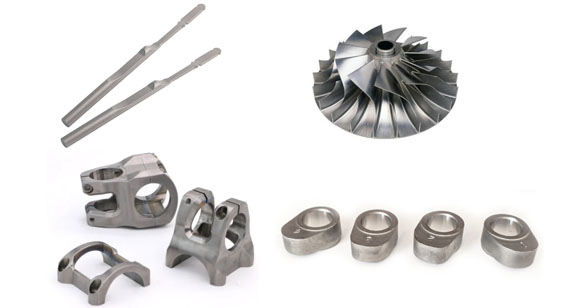
Due to their excellent biocompatibility and chemical passivity, titanium CNC machined parts deliver superior corrosion resistance (against strong acids, alkalis, and chlorides), lightweight properties, high strength, and hardness. In precision applications across aerospace, marine, chemical, and medical industries, titanium offers unmatched comprehensive performance compared to stainless steel, aluminum, or brass. However, CNC titanium alloys like Grade 5, Grade 7, and Grade 9 inevitably incur higher production costs due to expensive raw materials and high machining difficulty.
This article will break down the exact reasons behind the high cost of titanium machined parts. More importantly, we will share practical strategies to lower your manufacturing expenses: from optimizing tolerance allocation and part geometry (DFM design tips) to selecting efficient manufacturing processes (near-net shaping + precision machining) and leveraging factory-level tooling and coolant setups. Finally, we will present a case study detailing how we solved surface finish and sealing issues for a client's titanium valve assembly.
The elevated manufacturing cost of titanium CNC machined parts can be attributed to several factors that collectively contribute to the overall expense. Here's an overview of why the production cost of titanium CNC machined parts tends to be high:
1. High Raw Material Costs of Titanium
Titanium is an expensive material compared to more common metals like aluminum or steel, and this is primarily due to the expensive alloy elements of titanium and an energy-intensive process (the Kroll process) under inert gas environments. The high material cost of titanium significantly influences the overall manufacturing expense.
Titanium Price vs Other Metals’ Price
| Material | Primary Elements | Relative Raw Material Cost |
| Aluminum 6061 | Mg, Si, Al Basel | 1.0x (Baseline Reference) |
| Carbon Steel 1018 / 1045 / 1095 | Fe, C, Mn, Fe Base | 1.2x – 1.8x |
| Stainless Steel 304 / 316L | Cr, Ni (Mo for 316),Fe Base | 3.0x – 4.5x |
| Titanium Grade 9 (Ti-3Al-2.5V) | 3% Al, 2.5% V, Ti Base | 12.0x – 15.0x |
| Titanium Grade 5 (Ti-6Al-4V) | 6% Al, 4% V, Ti Base | 15.0x – 20.0x |
| Titanium Grade 7 (Ti-Pd) | 0.15% Palladium,Ti Base | 25.0x – 35.0x+ |
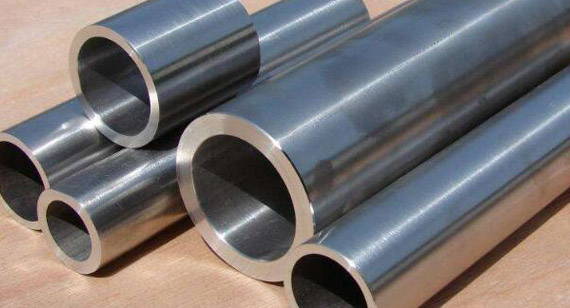
2. High Machining Difficulty of Titanium
Due to lower cutting speeds, rapid tool wear, and rigid setup requirements, the overall machining labor cost, for example, machining cost of titanium grade 5 is typically 3x to 5x higher than stainless steel 304 and 8x to 10x higher than aluminum 6061.
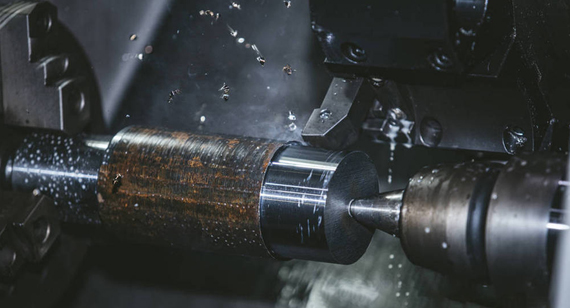
Titanium is known for its high strength and hardness. Machining this material requires specialized tools and cutting techniques, leading to increased tool wear and replacement costs.
CNC Machining titanium is abrasive, causing faster wear and tear on cutting tools. Frequent tool changes and the use of high-performance tooling contribute to increased production costs.
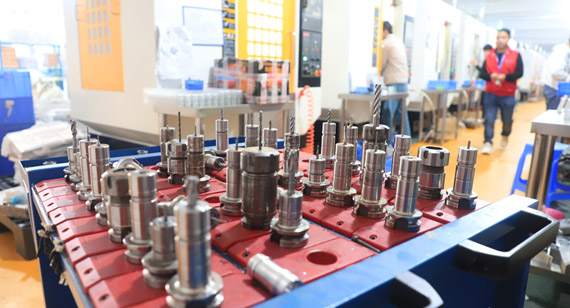
Titanium has lower machinability compared to some other metals. Its propensity to work-harden during machining necessitates careful consideration of cutting parameters, slowing down the CNC machining process.
Titanium's resistance to deformation and high melting point require more energy during the CNC machining process. This increased energy consumption contributes to higher operating costs.
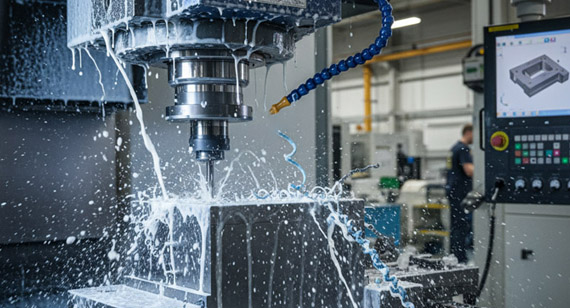
Titanium machining often requires extensive use of coolants and lubricants to dissipate heat generated during cutting. Managing these fluids adds to the operational costs.
Titanium CNC machining demands robust and specialized CNC machines with features designed to handle the challenges posed by this material. The investment in such equipment adds to the overall manufacturing cost.
Titanium CNC machining parts often require additional post-processing steps, such as heat treatment or surface finishing(e.g., polishing), to meet specific performance and aesthetic requirements. These additional steps contribute to the overall cost.
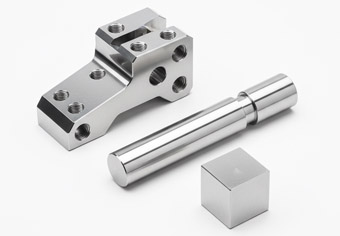
The difficulty in CNC machining titanium increases the likelihood of scrap and waste during the manufacturing process. Minimizing waste requires precision and meticulous control, adding complexity and cost.
Machining titanium demands a high level of expertise. Skilled machinists who understand the intricacies of working with titanium are essential, and their expertise often comes at a premium, contributing to labor costs.
The order quantity will also affect the cost of titanium CNC machining parts. This is very simple. The greater the purchase quantity, the greater the cost savings! There is no MOQ requirement in VMT, we treat it equally whether it is a small batch or a large batch.
While titanium raw materials and machining are inherently expensive, smart design choices and optimized manufacturing strategies can significantly reduce your overall project cost. Based on our years of precision machining experience at VMT, here are four practical engineering strategies to optimize titanium part costs without compromising performance.
Optimize Tolerance Design (Avoid Over-Specification)
One of the most effective ways to lower costs is rational tolerance allocation of CNC machined titanium parts. Precision machining titanium to ultra-tight tolerances requires very low feed rates, frequent tool checks, and constant thermal management.
Design for Manufacturability ( Part Geometry Optimization)
Titanium’s low elasticity modulus and high cutting forces mean certain geometric features dramatically increase machining risk and cycle time. Optimizing titanium part geometry prevents tool chatter and part deflection for better quality.
Combine Near-Net Shape Blanks with Precision Machining
Because titanium raw material is expensive, generating large amounts of machining chips (high buy-to-fly ratio) is a major waste of budget.
Leverage Shop-Level Tooling & Coolant Practices (Factory Side)
The right shop-level tooling setup makes a massive difference in cutting efficiency and scrap prevention. At VMT CNC machining factory, we utilize specialized machining setups refined over years of hands-on titanium parts production:
Optimizing CNC Machining for a High-Pressure Titanium Valve Assembly
A marine industry client required custom Grade 5 Titanium (Ti-6Al-4V) valve body assemblies for underwater fluid control systems. The client’s previous supplier produced valve components with quality issues, including surface finish failures (exceeding the required Ra 0.4 µm) and dimensional instability caused by titanium galling and micro-deflections. As a result, excessive tool wear drove part dimension drifts and led to a prohibitive 12% scrap rate and long lead times.
Solution
Our engineering team conducted a thorough project review and implemented a comprehensive DFM and machining optimization plan:
Results
While titanium CNC machined parts demand a premium due to high raw material prices and severe cutting challenges, their unmatched strength-to-weight ratio, biocompatibility, and corrosion resistance make them indispensable for high-performance medical, aerospace, marine, and chemical applications. By understanding the root causes of these manufacturing expenses and implementing smart DFM optimization, such as rational tolerance allocation, cavity geometry design, and batch scale planning, you can significantly lower per-part costs without compromising quality. Ready to optimize your titanium part design and cost? Contact our engineering team today to submit your drawings for a free DFM review and competitive quote![2D Drawings (PDF files), 3D Drawings (IGS/STP/STEP files)].
Send your 2D drawings, 3D CAD models, titanium grade, dimensional tolerances, surface-finish requirements, prototype quantity and production quantity. VMT will review your titanium part design, machining risks, manufacturing process and cost requirements.
All information and uploaded files are secure and confidential.
1 Tell us what you need
2 Get solution & quote
3 Approve production
Email: inquiry@vimetal.com.cn
Q1: Is Titanium harder to CNC machine than Stainless Steel 316?
Yes, titanium is significantly harder to machine than Stainless Steel 316 due to its lower thermal conductivity and high chemical reactivity. Heat accumulates at the cutting edge rather than dissipating into chips, which accelerates tool wear and causes work-hardening.
Q2: Which Titanium grade is the most cost-effective for CNC machining? (Grade 2 vs Grade 5)
Grade 2 Titanium is generally more cost-effective for basic machining because it is commercially pure, softer, and cuts easier than alloyed grades. However, Grade 5 (Ti-6Al-4V) offers much higher strength-to-weight performance, making it the most cost-effective choice when high mechanical strength is required.
Q3: How can I reduce the manufacturing cost of custom Titanium CNC parts?
You can reduce costs by relaxing non-critical tolerances (e.g., to ±0.02 mm), increasing internal corner radii to allow larger tooling, and avoiding thin wall designs. Additionally, ordering in larger batch sizes amortizes setup costs, and utilizing near-net-shape blanks minimizes expensive material waste.
Q4: Why do CNC cutting tools wear out so fast when machining titanium?
Titanium trapped friction heat at the tool edge because of its poor thermal conductivity (~6.7 W/m·K), leading to extreme thermal degradation. Furthermore, its tendency to spring back and weld to the cutting tool (galling) causes frequent chipping and rapid flank wear.
Q5: What is the standard tolerance and surface roughness achievable for Titanium CNC turning/milling?
Standard achievable tolerances for precision titanium CNC machining range from ±0.01 mm to ±0.05 mm, with tighter tolerances down to ±0.005 mm available upon request. For surface finish, standard CNC milling achieves Ra 1.6 µm to Ra 0.8 µm, while fine turning or secondary lapping can reach Ra 0.4 µm to Ra 0.2 µm.
Q6: Why choose Titanium over Aluminum 6061 for medical and marine precision parts despite the high cost?
Titanium offers non-negotiable material performance, including superior biocompatibility for medical implants and immune resistance to saltwater corrosion in marine environments. Unlike Aluminum 6061, titanium retains extreme strength at higher temperatures and resists harsh chemicals without degrading over time.
The technical information and manufacturing advice shared on the VMT website are for general guidance only. While we strive for accuracy, VMT does not guarantee that the processes, tolerances, or material properties mentioned are applicable to every specific project. Any reliance you place on such information is strictly at your own risk. It is the buyer's responsibility to provide definitive engineering specifications for any production orders. Final specifications and service terms shall be subject to the formal contract or quotation confirmed by both parties.


 +86 15099911516




 Read more