16 years one-stop China custom CNC machining parts factory

Hey there I’m VMT Sam!
With 25 years of CNC machining experience we are committed to helping clients overcome 10000 complex part-processing challenges all to contribute to a better life through intelligent manufacturing. Contact us now
 143 |
Published by VMT at Mar 13 2026 | Reading Time:About 2 minutes
143 |
Published by VMT at Mar 13 2026 | Reading Time:About 2 minutes


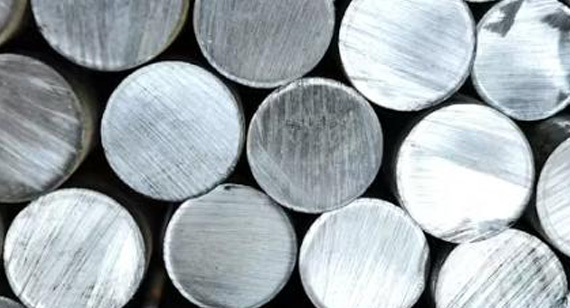
Maybe you are familiar with many high-strength, lightweight aerospace-grade aluminum alloys like 7050, 7075, or 2024. With so many aerospace materials available, why choose 2018 aluminum?—this forgeable and CNC-machinable metal material is widely used in defense and aerospace.
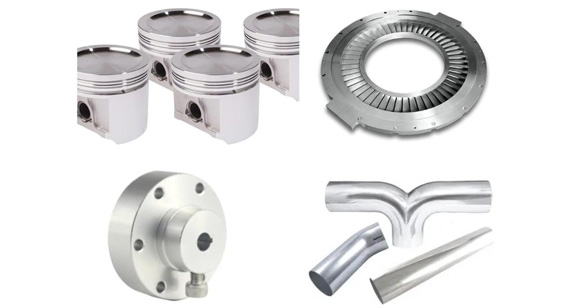
As a heat-treatable, aerospace-grade material belonging to the 2000 series defined by the Aluminum Association (AA)—2018 aluminum maintains excellent mechanical strength at temperatures above 200°C, where 7075 or 2024 alloys begin to fail. Its most typical applications are in internal combustion engine pistons (exposed to high-temperature airflow) and high-temperature intake manifolds; among these materials, 2018 aluminum is the one that best meets the requirements.
If you want to learn more about the excellent mechanical properties, thermal stability, and creep resistance of 2018 aluminum, along with its heat treatment states and advice on forging and CNC machining, please read on. Also, you can find supplementary physical properties and equivalent grades at the end of the article.
The 2000 series aluminum alloys all use copper as their primary alloying element, and 2018 aluminum is the same. During the heat treatment process, copper enables age hardening by forming precipitate phases, which boosts the mechanical strength of 2018 aluminum. Also, magnesium works with copper to further enhance the age hardening effect and slightly improve the relatively poor corrosion resistance of 2018 aluminum (the corrosion resistance of 2000 series copper-based and 7000 series zinc-based alloys is relatively low among aluminum alloys).
Another key element is the addition of nickel, which provides excellent high-temperature stability (200-300°C) and reduces the coefficient of thermal expansion (so parts do not expand easily at high temperatures, maintaining stable dimensional accuracy).
The table below shows the primary components and their roles:
Table 1: Chemical Composition of 2018 Aluminum
| Symbol |
Element |
Content (%) |
Role in 2018 Aluminum |
| Al |
Aluminum | Balance | Matrix metal. |
| Cu |
Copper | 3.5 – 4.5% | Primary strengthening element: enables age hardening through precipitate phases, significantly boosting mechanical strength. |
| Ni |
Nickel | 1.7 – 2.3% | Heat resistance: provides excellent high-temperature stability (200°C–300°C) and reduces the thermal expansion coefficient. |
| Mg |
Magnesium | 0.45 – 0.9% | Synergistic strengthening: works with copper to further enhance the age hardening effect and slightly improve corrosion resistance. |
| Fe |
Iron | ≤1.0% | Impurity control: must be kept low to prevent the material from becoming brittle. |
| Si |
Silicon | ≤0.9% | Improving fluidity: beneficial for the forging and shaping process. |
| Ti |
Titanium | ≤0.15% | Grain refinement: improves the uniformity of the microstructure. |
The mechanical properties of Aluminum 2018 vary under different heat treatment tempers. Typically, the 2018-T61 temper (solution treatment + artificial under-aging)—often used for aerospace pistons, compressor blades, intake and exhaust ducts, turbine housings, brackets, and propeller hubs—provides good mechanical strength, optimal creep resistance, and dimensional stability. The mechanical properties of 2018 aluminum under different tempers are shown below:
Table 2: Mechanical Properties of Aluminum 2018 Under Different Tempers
| Temper |
Tensile Strength (MPa) |
Yield Strength (MPa) |
Brinell Hardness (HB) |
Elongation (%) |
Characteristics |
| O (Annealed) |
200– 260 | 70 – 150 | ~50 | >20% | The softest state, suitable for initial forging blanks. |
| T4 (Naturally Aged) |
380– 440 | 240– 280 | ~105 | ~18% | Moderate strength with better ductility than T6, balancing forming and load-bearing. |
| T6 (Artificially Aged) |
430– 520 | 320 – 380 | ~135 | ~8% | Highest strength and hardness at room temperature. |
| T61 (Specialized Aging) |
~420 | ~310 | ~120 | ~10% | Provides optimal creep resistance and dimensional stability. |
The table below also clearly demonstrates the advantages of 2018 aluminum in high-temperature creep resistance (where strength does not easily fail at high temperatures, making it safer):
Table 3: Properties of 2018 Aluminum vs. Other Aerospace Aluminum Alloys
| Property |
2018-T61 (Heat Resistant) |
2024-T3 (High Fatigue) |
7075-T6 (Max Strength) |
7050-T7451 (Stress Corrosion) |
| Room Temp Tensile (MPa) |
~420 | ~470 | ~570 | ~520 |
| 200°C Tensile (MPa) |
~250 | ~170 | ~150 | ~140 |
| 300°C Tensile (MPa) |
~110 | ~60 | Fails (<40) | Fails (<40) |
| Creep Resistance |
Excellent | Moderate | Poor | Poor |
| Thermal Expansion (um/m.K) |
22.5 | 23.2 | 23.6 | 23.5 |
| Machinability (Rating) |
B (Good) | A (Excellent) | B (Good) | B (Good) |
| Primary Use Case |
Engine/Pistons | Fuselage/Wings | Structural Ribs | Heavy Spars |
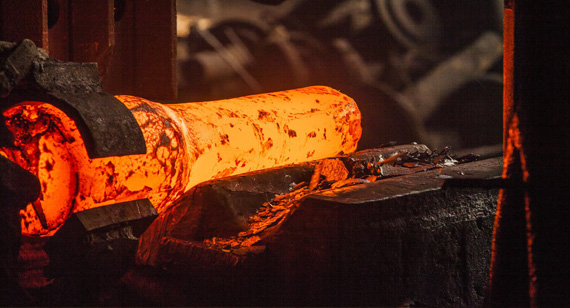
2018 aluminum alloy was originally designed for forging pistons and aircraft engine parts. For the forging of 2018 aluminum, you need to pay attention to temperature control to avoid grain boundary melting (also known as Overburning). Parts that have been overburned are prone to brittle fracture when under pressure—essentially rendering the part scrapped.
Advice on Forging:
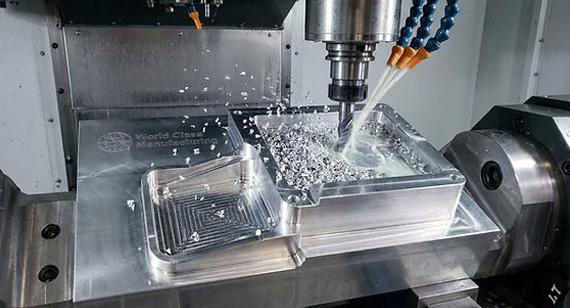
The machinability of 2018 aluminum alloy is relatively good; the machinability rating for 2018-T6 is 70-75% (based on 2011-T3 as the 100% benchmark).
Due to its high hardness (especially in the T61 state), its cutting performance is excellent. Chips break easily and the surface finish is high, making it very suitable for precision CNC milling and turning.
Parts such as propeller hubs (high-feed roughing), pistons (micron-level ring groove precision), impellers (surface finish), and sensor housings (fine threads, sealing surfaces) can undergo secondary processing via CNC turning and milling after forging to ensure high requirements like precision and sealing. Forging typically lacks the precision of CNC machining but offers good surface quality, faster forming, and material savings.
Advice on CNC Machining:
Table 4: Physical Properties of 2018 Aluminum
| Property |
Value |
| Density |
2.80 g/cm³ |
| Melting Point |
532–638°C |
| Thermal Conductivity |
155 W/m-K |
| Shear Strength |
262 MPa |
Table 5: Other Names for 2018 Aluminum
| Region |
Equivalent Grade |
| UNS (USA) |
A92018 |
| EN (Europe) |
EN AW-2018 (Wrought Aluminum) |
| ISO (International) |
Al Cu4NiMg |
| GB/T (China) |
2A18 (Closest heat-resistant functional equivalent) |
| JIS (Japan) |
A2018 |
| SAE (Aerospace) |
AMS 4140 |
2018 aluminum is an alloy suitable for both CNC machining and forging processes—ideal for producing pistons or engine components for high-temperature, high-load applications. Despite its slight limitations in corrosion resistance, 2018 aluminum (especially 2018-T61) proves to be superior to other aerospace materials like 7075, 7050, and 2024 in high temp uses. Its excellent mechanical strength, thermal dimensional stability, and high-temperature creep resistance, making it the better choice for lightweight materials that must maintain structural integrity at 200-300°C.

In a recent project, a European customer contacted VMT to machine a batch of engine piston crown inserts that would be subject to high loads. The customer initially considered using 7075 aluminum. However, since the pistons need to withstand high temperatures for long periods during operation (racing applications), 7075 carries a high risk of strength failure. Based on this, we suggested switching to 2018-T61 aluminum forgings as the blanks for secondary precision CNC machining.
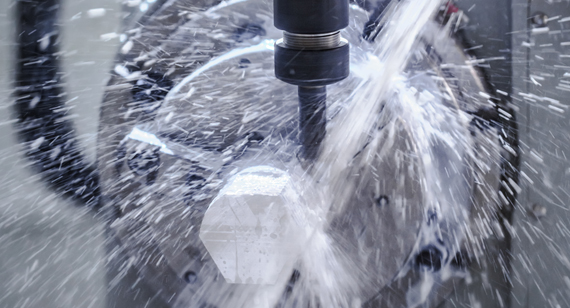
Since 2018-T61 contains about 2% nickel, the material's abrasiveness is quite demanding on tools. During the secondary machining phase, VMT utilized diamond-like carbon (DLC) coated carbide tools paired with a high-pressure internal cooling system, effectively solving the issue of thermal wear on the cutting edges. For precision areas such as piston pin holes and ring grooves, we implemented a "high speed, low feed" machining strategy. By taking full advantage of 2018 aluminum's high hardness and easy-to-break chip characteristics, we achieved an excellent surface finish (Ra < 0.8), ensuring the sealing and fatigue life of the parts in high-temperature and high-pressure environments.
Through precision CNC secondary machining of the forged blanks, VMT successfully controlled the tolerances for this batch within 0.01mm. During the final inspection phase, we used a Coordinate Measuring Machine (CMM) to perform thermal simulation verification on critical dimensions. The results showed that 2018-T61 parts exhibited significantly better expansion consistency after heating compared to conventional aerospace aluminum.
Is 2018 aluminum expensive?
As an aerospace-grade aluminum, 2018 is relatively expensive. Its price is typically 2 to 3 times that of the commonly used 6061 aluminum.
How is the corrosion resistance of 2018 aluminum?
Compared to the 5000 series (marine grade) and 6000 series (structural grade), 2018 aluminum has poorer corrosion resistance. Due to its high copper content, it is susceptible to intergranular corrosion. When used outside of a sealed engine environment, anodizing is usually required.
What is the difference between 2017 aluminum and 2024 aluminum?
2017 aa is the earliest duralumin with moderate strength; 2024 is a high-strength standard aerospace aluminum. While they are both strong, neither offers the excellent high-temperature and creep resistance of 2018 (which is provided by the nickel content).
Which is stronger, aluminum 6061 or 5052?
Aluminum 6061-T6 (tensile strength ~310 MPa) is significantly stronger than 5052-H32 (tensile strength ~230 MPa). The advantage of 5052 lies in its better formability and excellent corrosion resistance.
Can 2018 aluminum be welded?
Welding 2018 aluminum is generally not recommended. As a typical 2000 series alloy with high copper content, it is highly prone to hot cracking and severe intergranular corrosion in the heat-affected zone, leading to a significant drop in joint strength.
What happens if the preheating temperature exceeds 530°C during forging?
When the temperature exceeds 530°C, the low-melting-point grain boundaries inside the alloy begin to melt, creating microscopic voids within the material. This "overburning" results in a massive drop in ductility and fatigue strength. This damage is irreversible (it cannot be fixed by re-heat treatment), and the part must be scrapped.


 +86 15099911516




 Read more