16 years one-stop China custom CNC machining parts factory

Hey there I’m VMT Sam!
With 25 years of CNC machining experience we are committed to helping clients overcome 10000 complex part-processing challenges all to contribute to a better life through intelligent manufacturing. Contact us now
 57 |
Published by VMT at Jul 10 2026 | Reading Time:About 4 minutes
57 |
Published by VMT at Jul 10 2026 | Reading Time:About 4 minutes


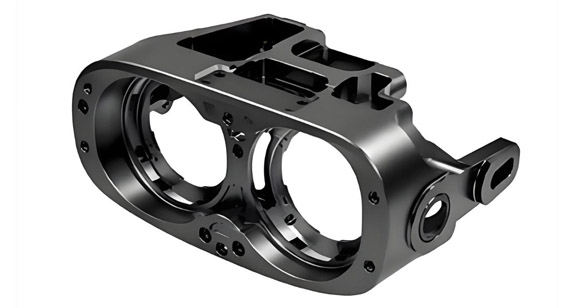
Driven by the continuous evolution of the metaverse and virtual reality (VR) hardware, modern VR headsets and controllers demand more than ever from their structural components. Whether it’s an ergonomic, lightweight, durable casing with a premium finish, or a series of ultra-precise, lightweight internal structures, the hardware requirements are exceptionally high. In VR manufacturing, precision CNC machining stands out as the ultimate production process—capable of meeting strict assembly tolerances, achieving superior surface quality, handling complex geometries, and adapting to design flexibility.
This article provides a practical engineering reference for CNC-machined VR headset parts, covering application scenarios, material selection, surface finishing, and manufacturing challenges. Additionally, we end up with a case study from our factory, sharing how our engineering team optimized the machining process to prevent warping in a unibody VR internal frame, achieving perfect micron-level alignment.
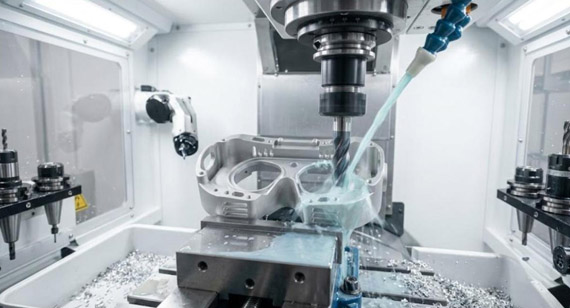
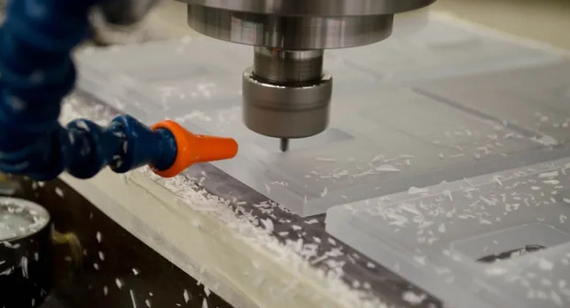
CNC machining is a subtractive manufacturing technology that uses digital computer programs to guide cutting tools(Using computer programming to control the operation of lathes or various cutting tools). By precisely removing excess material from a solid block of raw stock, it carves out the exact shape of the desired part.
For highly customized VR headset components, CNC machining offers several critical manufacturing advantages:
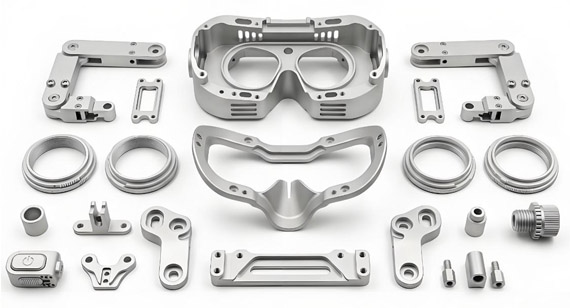
1. Internal Structural Frames & Support Systems
2. Optical & Perceptual Positioning Components
3. External Interactive Components & Connectors
4. Thermal Management & Production Support
According to the functional focus of different VR device components, CNC machining can perform precision operations on a wide variety of materials. The specific material selection is shown in the table below:
Material Selection for CNC-Machined VR Components
| Material |
Grades |
Application |
Characteristics |
| Aluminum & Magnesium Alloys | 6061, 7075 Aluminum Alloy / AZ31 Magnesium Alloy | Headset main frames, precision bezels, enclosures, custom mounting brackets | Low density, high rigidity, excellent machinability; highly beneficial for overall device weight reduction. |
| Titanium Alloys | Ti-6Al-4V Titanium Alloy | Structural skeletons for high-end models, specialized fasteners | Exceptionally high strength-to-weight ratio, superior corrosion resistance; delivers high structural rigidity while maintaining low weight; incurs higher machining costs. |
| Stainless Steel | 316, 416 Stainless Steel | Hinge pivots, miniature threaded drives, high-frequency plug/unplug connection interfaces | High fatigue strength, strong wear resistance, and excellent resistance to sweat corrosion; ensures smooth, long-term operation of moving parts without jamming. |
| Carbon Steel & Tool Steel | 45 Steel (Medium Carbon Steel) | Hidden internal load-bearing structures, locking buckles, fasteners | High hardness and mechanical strength with strong load-bearing capacity; effectively prevents structural parts from undergoing mechanical deformation. |
| Copper Alloys | Red Copper, Brass | Internal chip heat sinks, heat pipe conduction blocks, special grounding contacts | Extremely high thermal and electrical conductivity; rapidly dissipates processor heat to guarantee system operational stability. |
| Engineering Plastics | POM (Acetal), PC, PEEK, Nylon, etc. | Battery cover fasteners, insulating brackets, enclosures for antenna signal penetration zones | Excellent insulation properties with zero interference to wireless signals; high machining elasticity for microstructures; functionally complements metal skeletons. |
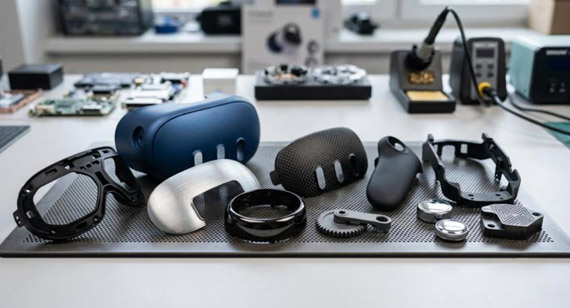
As consumer electronics, the components of VR devices must balance both cosmetic quality (for external structural parts) and functional requirements (for external or internal hardware). To help you make informed engineering decisions during the initial design phase, the table below compares mainstream surface finishing processes across dimensions of effects, application scenarios, and costs:
Comparison of Surface Finishing Processes for VR Components
| Process Name |
Cosmetic & Functional Effects |
Examples of Applicable VR Device Parts |
Cost & Process Characteristics |
| Sandblasting + Anodizing | Conceals minor tool marks to create a uniform matte texture and metallic coloration; enhances surface hardness, wear resistance, and sweat corrosion resistance. | Aluminum alloy headset outer frames, enclosures, lens frame supports, and frequently touched custom metal parts. | Medium Cost. The technology is highly mature and suitable for mass production, making it the most cost-effective solution for aluminum structural parts. |
| Brushing + Anodizing | Presents a directional, linear metallic texture with a high-gloss, premium tactile feel; also provides corrosion and wear resistance. | Aluminum alloy logo plates, high-end decorative trims, and other exposed visual parts that need to emphasize a metallic quality. | Upper-Medium Cost. Compared to sandblasting, brushing has a lower tolerance for original defects on the substrate surface, requiring stricter preprocessing. |
| Powder Coating (Spraying) | Strongly masks machining imperfections; provides rich color options and skin-friendly tactile feedback (such as a matte, soft-rubber texture); delivers insulation and scratch resistance. | Controller housings, handle grip areas, plastic or low-cost metal protective shells. | Lower Cost. Ideal for high-volume, large-surface-area parts; places low demands on the initial machined surface roughness (saving post-processing costs). |
| Electroplating | Gives parts a mirror-like metallic luster or chrome aesthetic; enhances surface electrical conductivity, reflectivity, and hardness. | Plastic or metal miniature buttons, decorative rings, and electrode contact points on charging docks. | Higher Cost. The process is relatively complex; due to environmental compliance requirements and rack plating limitations, the average cost for small-batch custom parts is high. |
| Precision Polishing | Removes machining tool marks to achieve a mirror-grade high gloss and flatness; reduces frictional resistance between moving parts. | Mating surfaces of hinge pivots (functionally reducing friction) and high-end mirror-finish exterior trims. | High Cost. Manual polishing or precision mechanical polishing is highly dependent on labor and cycle times; it is generally recommended only for critical local areas. |
| Passivation | Does not alter the original dimensions or appearance color of the part; removes free iron from the surface through chemical reactions to extend the lifespan of stainless steel. | Stainless steel miniature fasteners, internal hinge pivots, threaded inserts, and other concealed load-bearing parts. | Low Cost. A batch chemical immersion process that is fast to operate, serving as the baseline anti-corrosion support process for stainless steel parts. |
In the actual manufacturing and supply chain management of VR devices, the following common challenges should typically be addressed:
Challenge 1: Balancing Strict Assembly Tolerances for Miniature Parts with Design for Manufacturability (DFM)
The internal space of VR devices is highly constrained, containing a vast number of miniature, complex structures (such as micro-slots and precision alignment mechanisms). While pursuing micron-level tolerances, it is incredibly easy to encounter situations where cutting tools cannot enter or break easily.
Solution:
Challenge 2: Controlling Deformation in Lightweight Components Requiring High Structural Strength
Headset frames and enclosures require extreme thin-walled designs (local wall thicknesses are often reduced to 0.5 mm to 0.8 mm) to alleviate the load on the user's head. However, during the cutting process, the release of raw material residual stress and the conduction of cutting heat can easily cause thin-walled parts to warp, twist, or otherwise deform.
Solution:
Challenge 3: Time and Cost Pressures from Frequent Engineering Change Orders (ECOs) During Development
VR hardware is in a phase of rapid technological iteration. From rapid prototyping to compatibility verification, structures such as lens alignment parameters and sensor hole positions frequently face temporary, last-minute adjustments. Traditional manufacturing struggles to balance both speed and cost under these conditions.
Solution:
Challenge 4: Excessive Supplier Handoffs and Overall Quality Control in Multi-Process Projects
A cosmetic VR structural component often needs to undergo multiple processes, including machining, deburring, sandblasting, anodizing, local shielding electroplating, laser marking, and insert assembly. If these are handed off sequentially across multiple suppliers, it easily triggers out-of-control tolerance stack-ups and presents a high risk of surface scratching during transit, leading to poorly defined liabilities.
Solution:
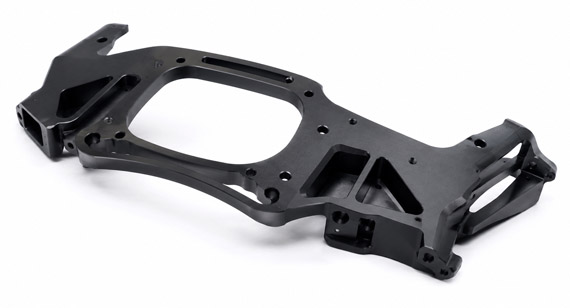
In a recent project, we undertook the rapid prototyping and low-volume production of a core internal frame for an all-in-one VR headset from a well-known hardware technology company. This component features a typical large overhang, ultra-thin-walled, irregular structure. With a designed wall thickness of only 0.8 mm, it required the overall flatness to be controlled within 0.02 mm, while integrating 12 high-precision threaded holes and custom sensor mounting brackets. Since the product was undergoing rapid design iteration, the client allowed us a fitment verification cycle of only 7 working days.
Machining and Solutions
Results
The final delivered frame not only exhibited a premium, flawless matte texture, but also achieved zero sensor alignment error during the client's full-device assembly testing. Furthermore, it successfully passed a 1.5-meter drop test. The entire project—spanning from ECO (Engineering Change Order) program modifications to final product delivery—took only 7 days, powerfully accelerating the client's product launch timeline.
Under the prevailing trend of VR hardware pursuing wearing lightweight and high functional integration, precision CNC machining—with its high flexibility, superior accuracy, and compatibility with multiple materials—has become an indispensable process chain linking design blueprints to mass-produced products. Whether it is overcoming thin-wall deformation, meeting micron-level assembly tolerances, or responding to high-frequency Engineering Change Orders (ECOs), high-standard CNC machining serves as the foundation for guaranteeing hardware performance.
Therefore, partnering with a one-stop, full-process manufacturing ally that possesses capabilities spanning from machining to surface finishing, alongside a robust Quality Control (QC) system, is the core element for VR brands to shorten product R&D cycles and secure the comprehensive yield rate of structural components. Are you currently advancing an R&D project for next-generation custom VR headset parts? Welcome to submit your drawings, and our engineering team will provide you with a professional DFM review and a precision machining quotation. [2D Drawings (PDF files), 3D Drawings (IGS/STP/STEP files)]

Q1: Is it better to choose aluminum alloy or magnesium alloy for VR structural components?
Aluminum alloy features mature processing technologies, moderate costs, and a wider selection of surface colors, making it suitable for most headsets and brackets. Magnesium alloy is about one-third lighter than aluminum alloy, offering excellent weight-reduction effects; however, it requires strict explosion-proof measures during machining and incurs higher costs. The specific choice depends on your actual requirements.
Q2: How does CNC ensure the alignment accuracy of multiple sensor hole positions on a headset?
This relies primarily on 5-axis CNC machining centers. By completing the cutting of all hole positions and datum planes in a single setup, it eliminates tolerance stack-ups caused by multiple re-clampings from the source. After machining, Coordinate Measuring Machines (CMM) are used for inspection to ensure that relative position tolerances are controlled within plus or minus 0.01 mm.
Q3: How can processing costs for VR parts be reduced during the design (DFM) phase?
It is recommended to implement three practices: maximize internal corner fillets as much as possible (to avoid using micro-diameter tools); maintain a wall thickness of no less than 0.8 mm while ensuring strength (to reduce labor hours spent on deformation control); and minimize complex structures that require multi-faceted setups.
Q4: When an Engineering Change Order (ECO) occurs, can a part that is already halfway through machining still be modified?
It depends on the type of change. If it is a subtractive change (such as adding new holes, pocketing, or thinning), it can be salvaged through secondary machining by rewriting the CNC program. If it is an additive change (such as thickening a locating boss or reducing a hole diameter), the material cannot be restored, and the part typically must be scrapped and remade.
Q5: Which surface finish is most wear-resistant and offers the best tactile feel for VR controller handles?
For metal handles, "Sandblasting + Anodizing" is recommended, as it is highly wear-resistant and protects against sweat corrosion. For engineering plastic handles, spraying a "skin-friendly matte paint" or "soft-touch paint" is recommended; this provides a non-slip, rubbery tactile feel while masking machining tool marks.
Q6: Why can't VR optical support components be 3D printed instead of being CNC machined?
3D-printed parts are prone to minor deformations under long-term stress or heat, and it is difficult to stabilize their tolerances within plus or minus 0.01 mm. Any deformation in an optical component will cause focal misalignment and blurry images. CNC-machined parts possess exceptionally high structural stability, ensuring lens alignment over the long term.
The technical information and manufacturing advice shared on the VMT website are for general guidance only. While we strive for accuracy, VMT does not guarantee that the processes, tolerances, or material properties mentioned are applicable to every specific project. Any reliance you place on such information is strictly at your own risk. It is the buyer's responsibility to provide definitive engineering specifications for any production orders. Final specifications and service terms shall be subject to the formal contract or quotation confirmed by both parties.


 +86 15099911516




 Read more