16 years one-stop China custom CNC machining parts factory

Hey there I’m VMT Sam!
With 25 years of CNC machining experience we are committed to helping clients overcome 10000 complex part-processing challenges all to contribute to a better life through intelligent manufacturing. Contact us now
 59 |
Published by VMT at Jul 17 2026 | Reading Time:About 4 minutes
59 |
Published by VMT at Jul 17 2026 | Reading Time:About 4 minutes


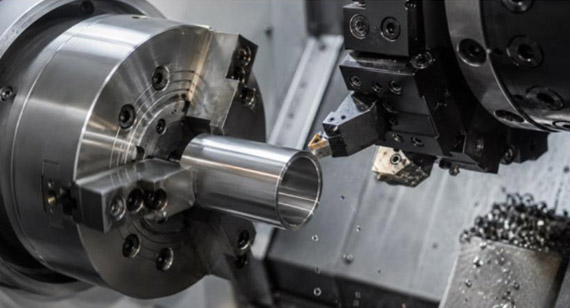
Custom bushings and sleeves are typically required to operate under high loads, heavy wear, frictional heat, or corrosive conditions. For custom bushings and sleeves, dimensional tolerances, concentricity, and surface finish are very important metrics. Although traditional manufacturing methods like 3D printing, stamping, or die casting can produce custom bushings or sleeves in different materials or shapes, only precision CNC machining can achieve tolerances of ±0.005 mm to ±0.01 mm, and a surface roughness of Ra 0.8 μm or lower to meet strict requirements for dimensional tolerances, concentricity, and surface finish.
This article will introduce the material selection, geometric shapes, CNC machining, and secondary operations of custom bushings and sleeves. At the end of the article, we will also share a case study of how our factory solved the assembly issue of custom stainless steel wear bushings for an industrial automation equipment client.
1. Custom Polyurethane Bushings and Sleeves
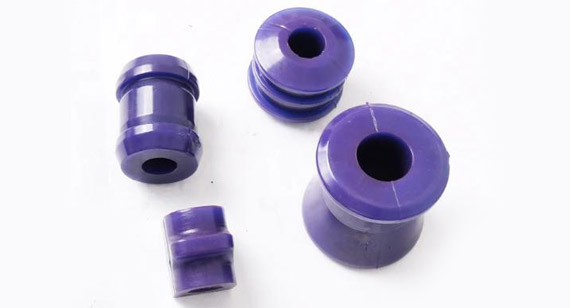
Custom polyurethane bushings (also referred to as custom poly bushings or custom urethane bushings) and sleeves are designed according to specific hardness and geometric shapes to resist highly corrosive chemicals, oil, and impact under load. Therefore, you can choose polyurethane to produce bushings or sleeves for automobiles, off-road vehicles, or some other industrial manufacturing.
2. Custom Tool Steel Bushings and Sleeves
For tool steel used to make bushings and sleeves, the most famous is O1 tool steel. These bushings and sleeves are mainly designed for high-load and heavy-wear applications. Hardened custom tool steel bushings and sleeves (eg. custom o1 bushings) can withstand high loads, while precision ground tool steel bushings and sleeves through secondary operations can reduce friction, and play a guiding and protective role for the wear layer in mechanical equipment.
3. Custom Rubber Bushings and Sleeves
For these custom rubber bushings and sleeves, the main function is to provide flexible load-bearing, cushion and absorb shock, reduce noise, and prevent wear between parts. For example, suspension systems in the automotive industry need shock absorption, and some vibration-sensitive electronic equipment also needs shock absorption.
4. Custom Bronze Bushings and Sleeves
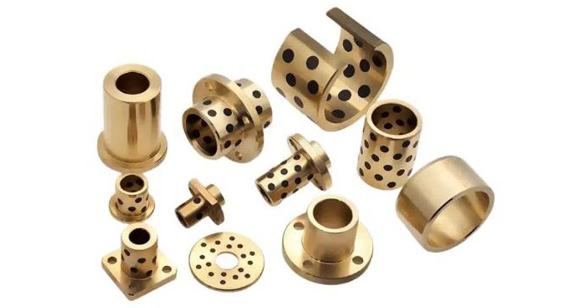
This class of bushings and sleeves mainly features high load-carrying capacity, excellent wear resistance, and corrosion resistance. Well, they are typically machined from SAE 660 bearing bronze. Many heavy-duty and highly demanding industries, such as gearboxes and conveyors of industrial machinery (custom gear bushings), steering knuckles and transmission components of automobiles, including deck machinery of some marine applications or fluid-handling equipment, might use custom bronze bushings or sleeves.
5. Custom Steel Bushings and Sleeves
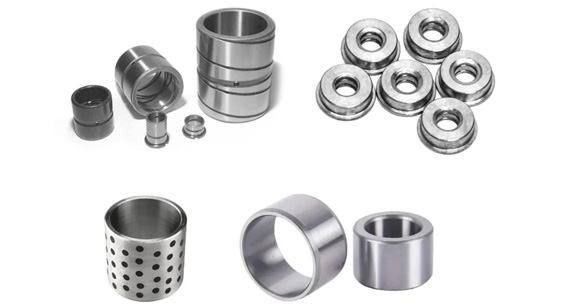
This class of bushings and sleeves includes carbon steel, alloy steel, and stainless steel. Custom steel bushings and sleeves made of carbon steel have relatively lower costs and higher capacity to absorb shock and loads. Stainless steel is relatively more corrosion-resistant, while alloy steel has different load or impact resistance capabilities depending on different grades. Relatively speaking, if they are exposed to marine or chemical processing like pumps, valves, and other components where steel bushings or sleeves are needed, custom stainless steel wear bushings are recommended as they are more corrosion-resistant. If higher strength, durability, and wear resistance are required, you need to choose specific carbon steel or alloy steel grades according to the needs. Finding something more about carbon steel vs stainless steel, alloy steel vs carbon steel to learn their main characteristics.
6. Custom Aluminum Bushings and Sleeves
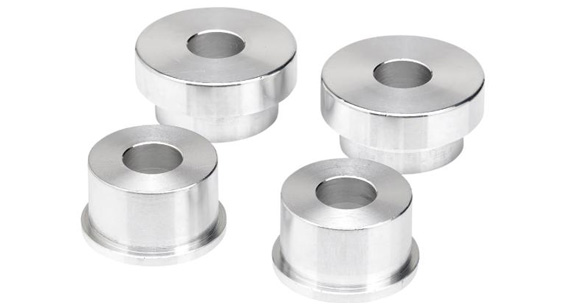
This class of bushings or sleeves has a relatively good strength-to-weight ratio, which means lightweight but also strong. In addition, this class also has good rigidity. Many applications use custom aluminum bushings or sleeves, such as automotive suspension bushings, aerospace aircraft interiors, lightweight robotic arms for industrial automation and robotics, and external bushings on some commercial adjustment rod brackets or shelves. This kind of aluminum bushing or sleeve (eg.aluminum cnc turning sleeves and bushings) also features very easy cutting and machining. That is to say, if threading, screw, or knob machining is required, choosing custom aluminum bushings or sleeves is very economical and practical. You can explore more aluminum grades to make bushings or sleeves.
7. Custom Brass Bushings and Sleeves
This class mainly consists of precision-machined copper-zinc alloy components. Their main feature is to reduce friction, withstand radial loads, and protect moving shafts from wear. This class of bushings or sleeves has its own unique characteristics, such as non-sparking properties. Since they do not generate sparks, custom brass bushings or sleeves are safe in environments containing volatile gases. In addition, they can achieve self-lubricating options, such as using sintering or oil-impregnation processes, which allow the custom brass bushings or sleeves to slowly release lubricant, making them more lubricated and lower friction, thereby reducing maintenance requirements. Relatively speaking, custom brass bushings or sleeves are slightly softer than bronze, relatively less resistant to friction and load than steel, and relatively less lightweight and rigid than aluminum bushings or sleeves. The specific requirements still need to be machined into bushings or sleeves according to different brass grades. Please explore more brass grades to discover more characteristics of different brass bushings or sleeves.
Quick Reference Table for Custom Bushings and Sleeves Materials
Here is a quick reference table of common bushing and sleeve materials to help you compare:
| Bushing and Sleeve Material |
Main Characteristics |
Where the Bushings and Sleeves are Used? |
| Custom Polyurethane Bushings and Sleeves | Oil-resistant, wear-resistant, impact-resistant, chemical-resistant | Automotive suspensions, industrial buffers |
| Custom Tool Steel Bushings and Sleeves | High hardness after hardening, heavy load and wear resistant | Guide sleeves, heavy machinery wear sleeves |
| Custom Rubber Bushings and Sleeves | Vibration damping, noise reduction, flexible support | Automotive shock absorption, sensitive electronic devices |
| Custom Bronze Bushings and Sleeves | High load capacity, wear-resistant, corrosion-resistant | Gearboxes, conveyors, marine deck machinery, custom gear bushings |
| Custom Stainless Steel Wear Bushings and Sleeves | Excellent corrosion resistance | Chemical pumps, valves, liquid-handling equipment |
| Custom Aluminum Bushings and Sleeves | Lightweight, easy to machine, good rigidity | Robotic arms, aircraft interiors, suspension bushings |
| Custom Brass Bushings and Sleeves | Non-sparking, low friction, self-lubricating options | Volatile gas environments, low-maintenance shaft sleeves |
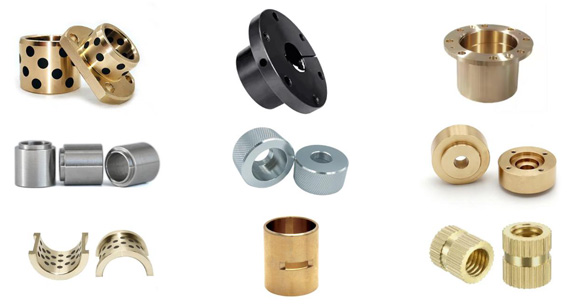
For custom bushings or sleeves, they will have different geometric shapes, and these geometric shapes affect the load-carrying capacity, installation convenience, positioning accuracy, and maintenance costs of the bushing or sleeve parts.
1. Custom Sleeve Bushings
This is the most basic class, presenting a cylindrical structure with uniform inner and outer diameters (cnc sleeve). Many general-purpose bushing or sleeve components use this class of geometric shape, which is highly cost-effective and suitable for mass production. In design, it should be noted that this type of bushing or sleeve must be tightened by a precise press-fit to prevent it from sliding out during rotation, so tolerances and precision are points that need extra attention. At the same time, because it needs to bear radial pressure, if it is a high-load application scenario, the wall thickness cannot be too thin to avoid deformation. In addition, the end face of the bushing must be designed with a lead-in chamfer to avoid scratching the hole due to misalignment during pressing.
2. Custom Flange Bushings or Sleeves
This class of bushings or sleeves has an added flange plate structure at one end of the cylinder, mainly suitable for applications that need to bear both radial loads and axial loads. For custom flange bushings or sleeves, it should be noted that the junction between the flange and the cylinder is a stress concentration area, and a reasonable transition fillet must be designed to prevent root fracture. In addition, the mating housing bore edge must also be designed with a corresponding chamfer to accommodate the transition fillet of the bushing, ensuring that the flange face can fit tightly against the housing end face. The thickness of the flange needs to be designed for strength according to the size of the axial thrust to avoid bending of the shape caused by excessive thrust.
3. Custom Split Bushings or Sleeves
This class of bushings or sleeves presents a structure composed of two halves or with an opening along the axis, mainly used for intermediate support of ultra-long shafts, shafts with welded parts, or large gears at both ends. These heavy equipment and machinery that require high-frequency maintenance and quick replacement of worn parts are more suitable for custom split bushings or sleeves. This shape of bushing or sleeve needs to consider custom positioning, step-matching slots, or matching housings like bearing caps in design to prevent the two halves of the bushing from misaligning or sliding axially during operation.
4. Custom Tapered Bushings or Sleeves
This class of bushings or sleeves presents a structure with a certain taper on the inner or outer diameter, similar to a conical surface. It is suitable for scenarios that require high-torque locking but do not want keyways on the shaft, well, to avoid stress concentration and shaft damage. For example, pulleys or sprockets that frequently need to be disassembled or adjusted in position will use custom tapered bushings or sleeves. In order to facilitate easy removal, tapered bushings or sleeves usually need to be designed with installation holes and removal thread holes. In addition, regarding the split width, there is usually a continuous slit design on the tapered bushing or sleeve. It is necessary to ensure that the slit width is moderate so that it can provide sufficient tightening elasticity and will not produce excessive deformation when locked.
5. Custom Threaded Bushings or Sleeves
This class of bushings or sleeves has a collar or thread structure machined on the outer wall or inner wall. Unlike ordinary press-in bushings or sleeves, it is not easy to slip out under strong axial impact or vibration. Generally speaking, when designing this class of bushings or sleeves, you need to plan for retention, such as set screw holes, using lock washers, or designing lock nuts at the tail. In addition, coarse threads are recommended under high loads to ensure strength, while fine threads are used in precision adjustment scenarios to improve adjustment accuracy. For the end face of the bushing, it is usually necessary to design a slot, cross slot, inner hex, or outer flat head for easy locking.
6. Custom Grooved Bushings or Sleeves
This class of bushings or sleeves has specific oil grooves or snap ring grooves machined on the inner and outer surfaces, which is very suitable for high-load, low-speed rotation, or reciprocating oscillation environments, such as scenarios where the bushing needs to be mechanically locked axially through an external snap ring. When designing grooved bushings or sleeves, attention should be paid to the shape and direction of the oil groove. For example, straight grooves are more suitable for linear motion; circular grooves and spiral grooves are more suitable for rotational motion, utilizing the rotation rate to apply lubricating oil evenly on the friction surface; figure-8 or double spiral grooves are more suitable for heavy-duty oscillation.
For the process selection of custom bushings or sleeves, the most critical point lies in precision. Other aspects are not actually the biggest limitations. Among the processing methods for different materials, 3D printing can apply different engineering plastics and different metals to make bushings or sleeves. Injection molding is very suitable for plastics to make bushings or sleeves. However, with any of these other manufacturing processes, it is very difficult to achieve tolerances, precision, and geometric dimensions of ±0.005 mm to ±0.01 mm. Moreover, bushings and sleeves made by other manufacturing processes are also very difficult to achieve surface finishes of Ra 0.4 μm to Ra 0.8 μm. This surface roughness and precision are actually very difficult to meet the standards by choosing other processes to make bushings or sleeves. Unless it is a very large volume, such as more than 10,000 pieces of bushings or sleeves to be made, you can choose other mass manufacturing processes to reduce costs, and then perform secondary CNC machining to achieve precision and surface finish, which is also a solution. But if it is a small batch, like 500 to 1,000 pieces, choosing cnc machined bushing and sleeves will be more economical and flexible.
Through basic CNC machining, the geometric shape and a certain surface finish of custom bushings or sleeves can be achieved. However, in order to make the bushings or sleeves meet the effects of high wear resistance, high precision, corrosion resistance, and long-term lubrication, secondary operations are usually required.
1. Heat Treatment
Heat treatment is mainly for steel and custom steel bushings or sleeves, using the heat treatment process to improve the hardness, wear resistance, fatigue strength, etc., of the bushings or sleeves. This process usually involves quenching to increase hardness, carburizing to increase surface hardness and wear resistance, and stress relief annealing to ensure dimensional stability.
2. Precision Grinding
Custom bushings and sleeves directly machined by CNC usually still need a precision grinding process. This process also belongs to the CNC machining process, but better precision can be achieved through precision grinding. For example, a precision of ±0.005 mm needs precision grinding to be better achieved. Bushings or sleeves used in some high-speed motors or precision instruments require this level of precision. Therefore, it is generally necessary to choose grinding as a secondary operation service to achieve this precision.
3. Surface Treatment
Different materials of bushings or sleeves can choose different surface treatments. Like the common ones, for example, custom stainless steel wear bushings, the passivation process can make the protective layer thicker and therefore more corrosion-resistant and wear-resistant. Another example is for custom steel bushings, you can choose hard chrome plating to form a harder, more corrosion-resistant, and more wear-resistant protective layer on the surface. And for custom aluminum bushings or sleeves, you can choose Type III hard anodizing, which also makes the aluminum bushings or sleeves more wear-resistant and durable.
4. Oil Groove Machining
This process is mainly to cut grooves of specific geometric shapes on the inner or outer wall of the bushing or sleeve, with the purpose of achieving better lubrication. Among the different geometric shapes we learned about earlier, one class is custom designed wear bushings with oil grooves (such as custom edpe wear bushings). This groove type is divided into straight grooves, circular grooves, figure-8 double spiral grooves, etc. This secondary operation is usually used in combination. For example, a typical manufacturing process flow for a heavy-duty precision shaft sleeve is often: first CNC machining the shape, then cutting the oil groove, then heat treatment to improve hardness, then precision grinding to achieve higher precision, and then blackening or electroplating surface treatment for steel bushings or sleeves to achieve better rust prevention and wear-resistant effects.
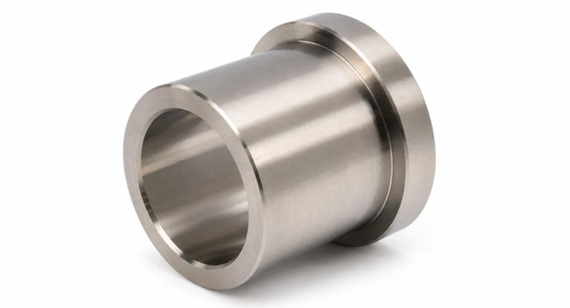
A US-based industrial automation equipment manufacturer needed to customize a batch of stainless steel sleeves for rotary shaft assemblies used in compact motion control systems. This stainless steel bushing part affects the mating rotation stability of the shaft, including noise and long-term wear performance. Before finding our factory, the client's previous custom bushing manufacturers delivered batch parts that could not meet their requirements of keeping the bushing bore tolerance within ±0.01 mm and the ID/OD concentricity within 0.02 mm. Their previous supplier had an ID deviation of ±0.02 mm and a concentricity deviation of 0.04 mm to 0.06 mm, which led to tight assembly, unstable rotation, abnormal noise, and a high scrap rate during assembly.
How did we solve it? After receiving the drawings, our engineering team reviewed the shaft fit, housing bore, wall thickness clamping methods, boring process, and inspection plan. Because stainless steel material is relatively tough, when processing thin-walled sleeves , if the clamping force is uneven, it is very easy to produce chuck clamping deformation.We redesigned special soft jaws for uniform circumferential clamping. On high-precision CNC turn-mill machines, we adopted a process sequence of "one setup to machine both the inner bore and outer diameter," which directly avoided alignment errors caused by multiple setups. During the boring stage, we optimized the boring tool rigidity and cutting parameters to eliminate chatter marks. During the production process, we introduced precision pneumatic internal diameter gages for real-time measurement. Finally, we controlled the internal bore tolerance within ±0.005 mm and improved the ID/OD concentricity from over 0.04 mm previously to within 0.015 mm. The internal bore surface roughness stably reached Ra 0.8 μm, and key dimensions were 100% inspected before shipment. This achieved smooth shaft assembly, lower noise, better operational stability, and a lower batch production scrap rate.
This article mainly introduced the characteristics and applications of various material choices for custom bushings or sleeves, the introduction and design key points of different geometric shapes of custom bushings or sleeves, the advantages of CNC machining processes, and secondary operation services. Materials, geometry, shapes, and machining processes will all affect various characteristics of custom bushings or sleeves, such as strength, precision, wear resistance, corrosion resistance, etc. Choosing a custom bushings manufacturer who understands different industry applications can help you customize bushings or sleeves more conveniently. Need custom flange bushings or sleeves, sleeve bushings, or other custom shaped bushings, or still have doubts about the materials and surface treatments of bushings? Welcome to contact our engineering team, and we have rich experience in the supply and production of bushings or sleeves and can provide you with one-stop machining services according to specific peformance and usage scenarios. [2D Drawings (PDF files), 3D Drawings (IGS/STP/STEP files)]
Send your drawings, requirements, and target quantity. VMT will review your project and provide a machining solution and quote.
All information and uploaded files are secure and confidential.
1 Tell us what you need
2 Get solution & quote
3 Approve production
Email: inquiry@vimetal.com.cn
1. What is a custom thrust collar bushing?
A custom thrust collar bushing is what we commonly call a flanged bushing or sleeve. Its biggest function is that it can bear both lateral pressure (radial load) and thrust along the shaft axis (axial load), making it very suitable for crane booms, automotive steering knuckles, and reciprocating rocker arms.
2. What materials should I choose for custom heavy equipment bushings?
The working conditions of heavy equipment are generally heavy loads, large impacts, and strong friction. Recommended materials for custom heavy equipment bushings fall into below examples:
3. How does a factory generally ensure burr control?
For burrs on internal bores, grooves, threads, cross holes, and sharp edges of bushings and sleeves, factories usually take manual deburring, mechanical deburring, ultrasonic cleaning, or visual inspection, and will re-inspect critical holes and locations before packaging.
4. What surface roughness should custom bushings or sleeves achieve?
For bore and OD surface finishes, if they need to meet friction, movement, sealing, and appearance requirements, the best way is through ordinary CNC machining combined with secondary grinding and polishing, which can achieve a best of Ra 0.2 to Ra 0.4 μm. This achieves a mirror-like surface finish, which is more suitable for sliding contact.
5. Is thread precision important for custom bushings or sleeves?
Very important. The pitch, depth alignment, and engagement quality of internal and external threads must be extremely precise and reliable. If they are too tight, too loose, have incomplete threads, or fail to meet precision standards, it will lead to misalignment during assembly and make assembly difficult.
6. Does the wall thickness of custom bushings or sleeves need to remain consistent?
Yes, it needs to remain consistent. The wall thickness of thin-walled sleeves, lightweight bushings, or press-fit parts all need to maintain consistency. If the wall thickness is uneven, it may lead to oval deformation or insufficient load-carrying capacity of the structure.
The technical information and manufacturing advice shared on the VMT website are for general guidance only. While we strive for accuracy, VMT does not guarantee that the processes, tolerances, or material properties mentioned are applicable to every specific project. Any reliance you place on such information is strictly at your own risk. It is the buyer's responsibility to provide definitive engineering specifications for any production orders. Final specifications and service terms shall be subject to the formal contract or quotation confirmed by both parties.


 +86 15099911516




 Read more