16 years one-stop China custom CNC machining parts factory

Hey there I’m VMT Sam!
With 25 years of CNC machining experience we are committed to helping clients overcome 10000 complex part-processing challenges all to contribute to a better life through intelligent manufacturing. Contact us now
 377 |
Published by VMT at Jan 15 2026 | Reading Time:About 2 minutes
377 |
Published by VMT at Jan 15 2026 | Reading Time:About 2 minutes


Have you ever wondered which aluminum alloy is the strongest? 7075 aluminum alloy is the alloy with the highest strength compared to other aluminum alloys. You might find this material is widely used in aerospace, high-load automotive structures, and high-end bicycle components. But even for blast-resistant shields and components of specialized sniper rifles, 7075 aluminum can be in the material lists. Besides its high strength, it also has key characteristics of average corrosion resistance, high hardness, good fatigue resistance, a high strength-to-weight ratio, and poor weldability. Read on to learn more about 7075 aluminum’s properties, uses, forms, and pros and cons.
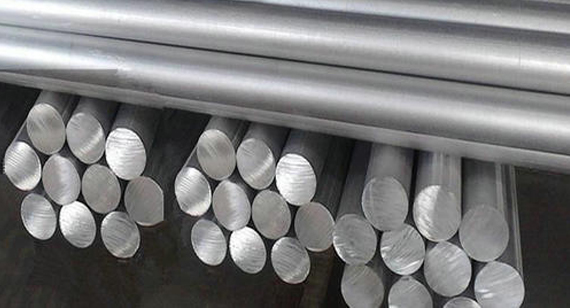
7075 aluminum alloy belongs to the 7xxx series of aluminum alloys, with zinc as its main alloying element. This alloy was originally developed for the aerospace industry for its high-strength, lightweight, and durable properties.

Compared to the same structural-used aluminum alloy 6061, 7075 aluminum surely has higher strength, making it more suitable for components with extremely high performance requirements, rather than general structural uses(for the cost, 6061 is more often used). Its high hardness, excellent fatigue strength, and high strength-to-weight ratio are also notable advantages, making 7075 aluminum particularly suitable for precision machining and high-load applications.
However, in terms of corrosion resistance, 7075 aluminum performs only moderately and is inferior to 6061, so if you plan to use 7075 aluminum in humid or corrosive environments, additional protection is required. Another feature about 7075 aluminum is that it has poor weldability, and it is generally not used for welded structures.
7075 aluminum alloy has various common names or trade designations across different regions, and all the followings are essentially the same 7075 aluminum alloy:
Table 1: Equivalent Name of 7075 Aluminum
| Type |
Name |
Notes |
| International Standard |
7075 Aluminum Alloy / Alu 7075 Alloy | Standard engineering designation |
| France / Europe |
Zicral | Common in aerospace and racing applications |
| Germany |
Ergal | Widely used in aerospace and high-strength structural components |
| Switzerland |
Fortal | High-performance industrial applications |
| USA / Military |
V95 | Used by specific military or certified suppliers |
| International Trade / Material Forms |
7075-T6 / 7075-T73 | Combined with temper designation, often used for machining and procurement |
Alu 7075 alloy is mainly composed of Aluminium (Al), Zinc (Zn),Copper (Cu),Chromium (Cr),and other trace elements. Chemical elements of 7075 aluminium and their roles are show in table below:
Table 2: Chemical Composition of 7075 Aluminum
| Element |
Content (wt%) |
Role |
| Zinc (Zn) |
5.6–6.1 | Main strengthening element |
| Magnesium (Mg) |
2.1–2.5 | Contributes to precipitation hardening |
| Copper (Cu) |
1.2–1.6 | Increases strength, improves hardness |
| Chromium (Cr) |
0.18–0.28 | Improves corrosion resistance and grain structure |
| Silicon (Si) |
≤0.4 | Impurity / trace |
| Iron (Fe) |
≤0.5 | Impurity / trace |
| Manganese (Mn) |
≤0.3 | Stabilizes microstructure |
| Titanium (Ti) |
≤0.2 | Controls grain size |
| Aluminium (Al) |
Balance | Base metal |
| Element |
Content (wt%) | Role |
Alu 7075 alloy is widely recognized for its exceptional strength-to-weight ratio, making it a popular choice for aerospace, automotive, and high-performance engineering applications. Its mechanical and physical properties vary depending on temper, but the T6 temper is the most commonly used due to its superior strength. You can find physical and mechanical properties of aluminium 7075 in below two tables:
Table 3:Physical Properties of Alu 7075 Alloy
| Property |
Typical Value |
Notes |
| Density |
~2.81 g/cm³ | Lightweight, about 1/3 of steel |
| Melting Point |
477–635 °C | Depends on exact alloying elements |
| Thermal Conductivity |
130–150 W/m·K | Moderate; lower than pure aluminum |
| Coefficient of Thermal Expansion |
~23.5 µm/m·°C | Typical for high-strength aluminum alloys |
| Electrical Conductivity |
34–38% IACS | Lower than pure aluminum due to alloying |
Table 4: Mechanical Properties of Alu 7075 Alloy (T6 Temper)
| Property |
Typical Value |
Notes |
| Tensile Strength |
572 MPa (83 ksi) | High strength for structural components |
| Yield Strength |
503 MPa (73 ksi) | Stable under repeated loading |
| Elongation at Break |
11% | Moderate ductility |
| Hardness (Brinell) |
150 HB | High hardness contributes to wear resistance |
| Fatigue Strength |
159 MPa (50% of tensile) | Excellent fatigue resistance under cyclic loading |
7075 aluminum alloy is typically used in different tempers to adjust its strength, hardness, and corrosion resistance. One common temper is 7075-O, the annealed state. In this condition, the alloy has lower strength but higher ductility, making it suitable for light forming or bending operations before further heat treatment.
Another widely used temper is 7075-T6 / T62, which is produced through solution heat treatment followed by artificial aging. This temper provides the highest strength and good dimensional stability, making it very common in industrial and aerospace applications where components must withstand high loads.
The third common temper is 7075-T73, which is overaged. While its strength is slightly lower than T6, it offers significantly improved resistance to stress corrosion, making it suitable for structural parts exposed to harsh environments. In practical manufacturing and CNC machining, 7075-T6 and T651 (a T6 variant with improved dimensional stability) are the most commonly used tempers, as they provide a well-balanced combination of high strength and dimensional reliability.
7075 Aluminum Advantages
You may consider 7075 aluminum when your design requires high localized strength in machined components or lightweight yet strong, durable uses are priorities. Key advantages include:
One of the highest-strength wrought aluminum alloys
7075 is an Al–Zn–Mg–Cu alloy that provides very high yield and tensile strength in the T6 and T651 tempers, making it suitable for strength-driven structural applications.
Exceptional strength-to-weight ratio
Compared with common 6xxx-series aluminum alloys, 7075 delivers significantly higher load-bearing capacity at similar weight, which is why it is widely used in aerospace structures.
Good fatigue performance
When properly heat treated and surface protected, 7075 aluminum exhibits favorable high-cycle fatigue resistance under repeated loading conditions.
Well suited for precision machining in the hardened condition
In the T6 / T651 condition, 7075 offers stable machining behavior, allowing high dimensional accuracy and good surface finish in CNC-machined components.
7075 Aluminum Limitations
You should avoid using 7075 aluminum when your design is driven by formability, corrosion resistance, or cost rather than peak strength(high strengh performance). Below are the limitations of 7075 aluminum:
Lower corrosion resistance than 6061 aluminum
Due to its relatively high copper content, 7075 has reduced corrosion resistance(only moderate corrosion resistance) and typically requires anodizing or protective coatings in corrosive environments.
Poor weldability with a high risk of cracking
7075 is highly sensitive to fusion welding. Welded joints suffer severe strength loss and are prone to hot cracking, so welding is generally avoided in engineering practice.
Higher cost than general-purpose aluminum alloys
Material price, heat treatment requirements, and machining costs are higher than those of common alloys such as 6061 or 6063, limiting its use in cost-sensitive applications.
Thanks to its exceptional strength-to-weight ratio, good fatigue resistance, and relatively good machinability after heat treatment, 7075 aluminum alloy finds uses in multiple industries such as:
Aerospace Industry
7075 aluminum alloy is a preferred material in the aviation industry due to its high strength and lightweight properties. It is commonly used in aircraft structural components such as wing spars, bulkheads, fuselage frames, and landing gear parts. It is also applied in aerospace accessories, gears, shafts, and missile components.
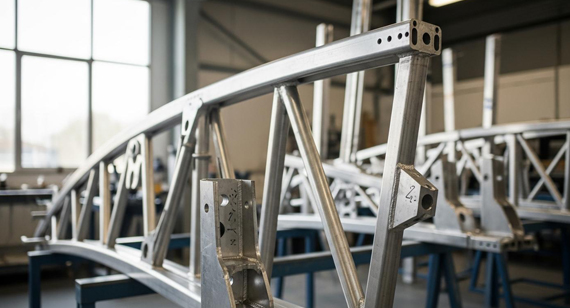
In the automotive sector, 7075 aluminum alloy is used in high-performance and racing vehicles for critical components such as control arms, wheel hubs, and suspension systems. Gears, connecting rods, and crankshaft guards also benefit from 7075 aluminum’s high strength properties.
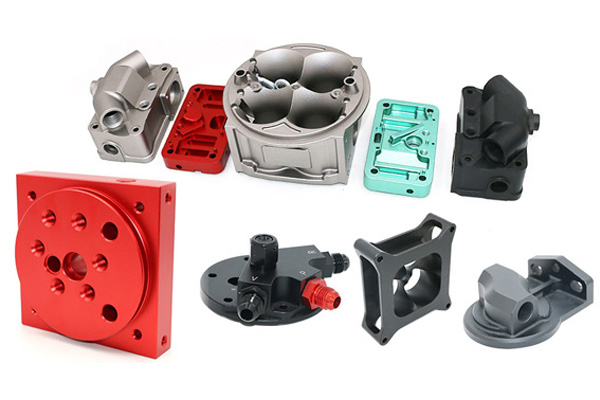
High-End Bicycle Parts and Other Sports’ Equipment
High-end bicycle frames and components widely utilize 7075 aluminum alloy to keep the whole bike’s strength and lightweight. It is also applied in climbing gear, bows, and other sports equipment that must withstand repeated stress and high loads.
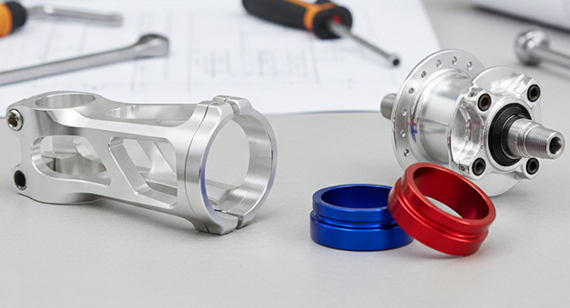
Defense and Military
7075 aluminum alloy can be used in some military and firearm components such as the upper and lower receivers of famous M16 and AR-15 rifles, as well as some other lightweight structural parts for the military. Its high strength ensures durability while lightweight property reduces overall weight.
Consumer Electronics For Limited Uses
In premium consumer electronics, 7075 aluminum is selectively applied to small CNC-machined internal components, including localized reinforcement features or threaded interfaces. But it is not typically used for housings or stamped structural parts because of its limited formability and higher cost.
Industrial Tools
7075 aluminum can be used for precision tools, jigs, and fixtures for 7075 aluminum’s high strength and machinability can ensure the parts’ durability and accuracy.
Many people are confused about “What is the difference between 6061 and 7075 aluminum? "It is a common concern in engineering material selection for both alloys that are widely used for precision machining and can be heat-treated to enhance mechanical properties. However, they can be different from each other among aspects of strength, ductility, machinability, corrosion resistance, and weldability, which affects their optimal applications.
1. Strength Differences
7075 has significantly higher strength than 6061. Typical T6 temper properties are:
Thus, 7075 is preferred for high-stress or locally load-critical components, and 6061 is adequate for most general load structural applications.
2. Ductility Differences
Ductility, often expressed as elongation at fracture:
This indicates that 6061 can undergo more plastic deformation before failure, whereas 7075 is more prone to brittle fracture in areas of stress concentration.
However, both alloys have limited cold forming capability compared with 5xxx or 3xxx series aluminum alloys, so they are not ideal for applications requiring large deformations.
3. Machinability Differences
Both alloys are suitable for CNC precision machining, but performance differs:
4. Formability
6061 has slightly better ductility than 7075 and can tolerate limited bending or minor local forming, but its cold forming capability is still modest. 7075 has low ductility and is restricted to precision machining rather than cold forming.
Therefore, for designs relying heavily on cold forming or large deformations, both alloys are limited, and more formable aluminum alloys may be preferred.
5. Corrosion Resistance
Both 6061 and 7075 can form protective oxide layers through anodizing, but 6061 generally offers better corrosion resistance in humid or mildly corrosive environments. The main reason is that 6061 has lower copper content and moderate magnesium content, which facilitates a more stable passive oxide layer.
6. Weldability
6061 can be welded using common fusion methods such as TIG or MIG. Welded joints experience reduced strength in the heat-affected zone (HAZ), which is unavoidable.Nevertheless, welded 6061 structures are used in industrial frameworks, mechanical supports, and light-load structural assemblies. 7075 is generally unsuitable for welding for its poor weldability.
7075 aluminum is a performance-driven material. With its very high strength, excellent fatigue performance, and outstanding strength-to-weight ratio, it is an indispensable choice in aerospace and other high-strength applications. Although it has limitations in corrosion resistance and weldability, 7075 aluminum remains a highly competitive option in applications where strength and reliability are critical.

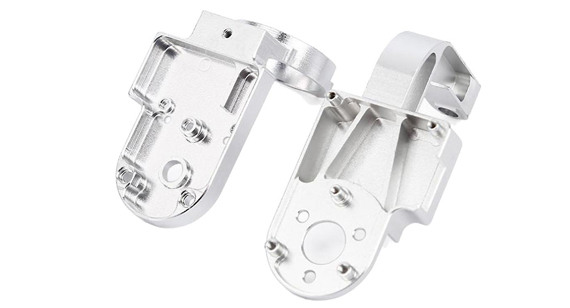
An UVA manufacturer required batch production of 7075-T6 aluminum control arm brackets for the wing mechanisms of a light UAV. The parts featured complex geometry, including multiple deep holes, angled surfaces, and tight-fitting locating slots, with strict dimensional tolerances of ±0.01 mm. High material strength was critical. Traditional suppliers struggled with inconsistent dimensions, short tool life, hole vibration, and excessive surface roughness, leading to delays and rework costs.
VMT Solution:
Results:

Q: What factors affect the price of 7075 aluminum?
A: The price of 7075-T6 aluminum is typically influenced by several factors, including the heat treatment condition and performance grade, the product form (sheet, plate, bar, or tube), the order quantity and tolerance requirements, and market supply and demand. Due to its high-performance positioning, 7075 aluminum generally costs more than 6xxx-series alloys.
Q: What are the common forms in which 7075 aluminum is supplied?
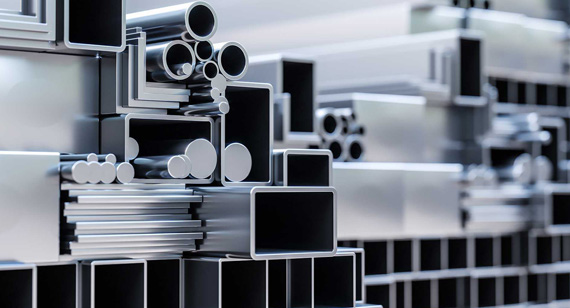
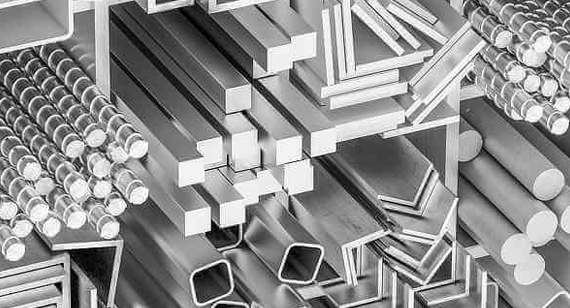
A: 7075 aluminum is typically supplied in a variety of industrial forms, including sheets and plates, round bars, tubes, as well as forged or machined components. These products are usually provided in T6 or T651 temper to meet structural and machining requirements.
Q: Why is 7075 Aluminum Alloy so “strong”?
A:The high strength of 7075 aluminum alloy mainly comes from two factors: its alloy composition and heat treatment capability. The combination of zinc with magnesium and copper makes 7075 aluminum highly responsive to precipitation strengthening. After proper heat treatment, its tensile strength ranks among the top of commercially available aluminum alloys.
Q: Can 7075 aluminum match the strength of steel?
A: On a per-volume basis, 7075 aluminum is not as strong as steel. However, in terms of strength-to-weight ratio, 7075 can approach some steels while significantly reducing weight, making it suitable for applications where weight savings are critical.
Q: What is the difference between 2024 aluminum and 7075 aluminum?
A: 2024 aluminum offers good toughness and fatigue resistance, whereas 7075 aluminum provides higher strength but has lower corrosion resistance. The choice depends on whether strength or fatigue/corrosion performance is the primary design requirement.
Q: What are equivalents to 7075 aluminum?
A: 7075 aluminum is known by various standard designations worldwide, including 7075 or UNS A97075 (USA), AW‑7075 (ISO), EN AW‑7075 or AlZn5.5MgCu (EU), AlZnMgCu1.5/3.4365 (Germany DIN), A7075(Japan JIS), 7075 (Australia/New Zealand AS/NZS), and 7075 (China GB/T).


 +86 15099911516




 Read more