16 years one-stop China custom CNC machining parts factory
Hey there I’m VMT Sam!
With 25 years of CNC machining experience we are committed to helping clients overcome 10000 complex part-processing challenges all to contribute to a better life through intelligent manufacturing. Contact us now
 54 |
Published by VMT at Aug 13 2026 | Reading Time:About 5 minutes
54 |
Published by VMT at Aug 13 2026 | Reading Time:About 5 minutes


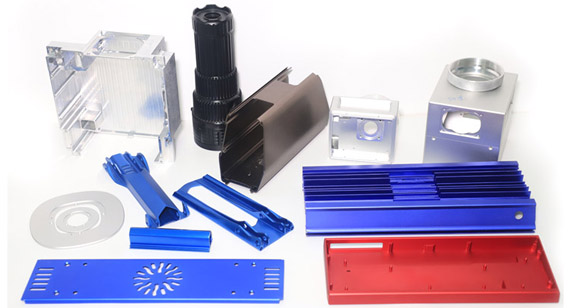
An aluminum extrusion can look straight after leaving the press and still bend, twist, or move during CNC machining. Poor control of stretching, profile geometry, clamping, or machining sequence can create unstable dimensions, thin-wall deformation, visible marks, assembly problems, and unnecessary scrap. Controlling stretching as part of the complete extrusion-to-CNC process helps reduce these risks.
Aluminum extrusion stretching is a controlled post-extrusion operation used to straighten profiles, reduce internal stress and distortion, and improve dimensional stability. The correct stretching condition is not one universal percentage; it depends on alloy, profile geometry, temper route, straightness requirements, and final part tolerances.
This guide explains how aluminum extrusion stretching works, what can go wrong, and how VMT controls extrusion blanks, CNC machining, inspection, and finishing when manufacturing precision aluminum parts.
Aluminum extrusion stretching is a controlled straightening operation carried out after an aluminum profile has been extruded and quenched. Both ends of the profile are gripped by a stretching machine and controlled tensile force is applied along its length.
The purpose is not simply to make the profile “longer.”
Stretching helps correct the bow and twist created during extrusion and cooling while reducing internal stress and improving dimensional stability. Industry guidance defines stretching as applying unidirectional force to create sufficient permanent set, reducing internal stress and distortion.
A typical extrusion manufacturing route includes:
Extrusion → Quenching → Cooling → Stretching/Straightening → Cutting → Aging → Secondary CNC Machining
AEC describes stretching as part of the material-handling sequence after extrusion and quenching, followed by operations such as cutting and artificial aging. Modern extrusion plants increasingly control stretching through repeatable process recipes according to profile geometry, alloy and tolerance requirements.
If you need a broader explanation of how the profile is created before this stage, see VMT's aluminum extrusion process guide.
Aluminum Extrusion Stretching Is Not the Same as Stretch Forming
These terms are easy to confuse.
Extrusion stretching or straightening mainly applies tensile force along a newly extruded profile to improve straightness and dimensional stability.
Stretch forming, however, intentionally bends a profile while it is under tension to produce a curved final geometry.
Deep drawing is another different manufacturing process and is normally associated with forming sheet metal into cups, shells or enclosures.
This distinction is important because the original phrase “aluminum shell stretching” can attract the wrong search intent.
For customers buying finished CNC machined extrusion parts, the real question is not whether the raw profile looks straight.
The more important question is:
Will it remain dimensionally stable after material is removed?
Extrusion and quenching can leave distortion and residual stresses in a profile. AEC notes that profile straightness, twist and bow are strongly affected by alloy, microstructure and extrusion process parameters, particularly thermal and quench conditions.
When CNC milling removes material from one side of an unstable profile, the internal stress balance can change. This becomes especially important for:
A machining supplier therefore needs to evaluate the extrusion blank and the CNC machining strategy as one manufacturing system.
Tip: Do not specify unnecessarily tight tolerances over an entire long extrusion when only several mounting, sealing or assembly surfaces are functionally critical. A DFM review can separate critical CNC features from extrusion-controlled geometry and reduce manufacturing cost.
1. Control the Extrusion and Quenching Stage
Dimensional stability does not begin at the CNC machine.
The extrusion temperature, die condition, puller control and quench strategy already influence profile geometry and residual stress before stretching begins.
Quenching must achieve the required material condition while avoiding unnecessary distortion. This is particularly important for long, thin or asymmetric profiles. AEC identifies quench control as a critical factor in both final material properties and dimensional distortion.
For a precision CNC project, VMT therefore considers not only the alloy designation but also the extrusion condition and the geometry supplied to machining.
2. Allow Controlled Cooling Before Stretching
After extrusion and quenching, the profile needs to reach the appropriate condition before straightening.
Rather than using one arbitrary temperature requirement for every profile, cooling criteria should be controlled according to the extrusion supplier's process, alloy, cross-section and temper requirements.
Uneven cooling can contribute to bowing, twisting and local dimensional variation, particularly when one side of the profile is significantly thicker than another.
3. Inspect the Profile Before Applying Stretch
Before stretching, the operator should understand where deformation exists.
Important characteristics may include:
The required correction for a simple rectangular extrusion may be very different from the correction needed for a thin-wall hollow enclosure.
4. Protect the Profile During Clamping
Stretching force is transferred through the gripping areas.
Incorrect clamp contact can deform thin features or leave marks that later remain visible after anodizing, bead blasting or polishing.
For decorative and precision profiles, suitable pads, gripping positions and sacrificial allowance should therefore be considered before production.
Areas that later become cosmetic surfaces should not be treated in the same way as non-visible trimming zones.
5. Use a Controlled Stretch Recipe
One of the most important corrections to the old article is this:
Do not treat “1% stretching” as a universal rule.
AEC explains that modern stretching systems increasingly require repeatable stretch recipes matched to profile design, alloy and tolerance specification.
Too little correction may leave unacceptable bow, twist or residual distortion.
Too much stretching may change dimensions, distort thin sections, damage the profile or affect mechanical condition.
The correct process therefore considers the complete part rather than relying on one fixed percentage for every extrusion.
6. Inspect Straightness and Cross-Section After Stretching
The profile should be checked again after stretching.
For CNC machining projects, inspection should not be limited to overall length.
Depending on the drawing, the extrusion may need checks for:
| Feature | Why It Matters |
| Straightness | Affects CNC setup and assembly |
| Bow | Can create inconsistent machining depth |
| Twist | Changes datum relationships |
| Width/height | Affects clamping and final stock allowance |
| Wall thickness | Influences deformation during milling |
| Opening geometry | Important for enclosure assembly |
| Cosmetic surfaces | Prevents finishing defects |
| Machining allowance | Ensures enough material remains for CNC finishing |
This provides a much more reliable starting point for precision machining.
Insufficient Straightening
A bowed extrusion may still be physically clamped into a CNC fixture.
That does not mean the problem has disappeared.
Once the clamps are released, the component may spring back and critical surfaces, hole positions or assembly features can shift.
Excessive Stretching
Over-correction can alter profile dimensions or produce local deformation in weak sections.
Thin ribs, narrow legs, open profiles and asymmetric shapes need particular attention.
Clamp Marks and Surface Damage
Gripping or handling damage may survive CNC machining if it lies outside the machined area.
After anodizing or another cosmetic finish, these defects can become more visible rather than less visible.
Thin-Wall Distortion
A profile can pass incoming inspection but still deform after a large pocket or internal cavity is milled.
This is why extrusion straightness alone cannot guarantee final CNC dimensional stability.
Twist Along Long Profiles
Even relatively small angular changes over a long component can affect the relationship between holes, mounting surfaces and mating components.
For customers buying assemblies rather than isolated dimensions, this can be more important than an individual ± tolerance.
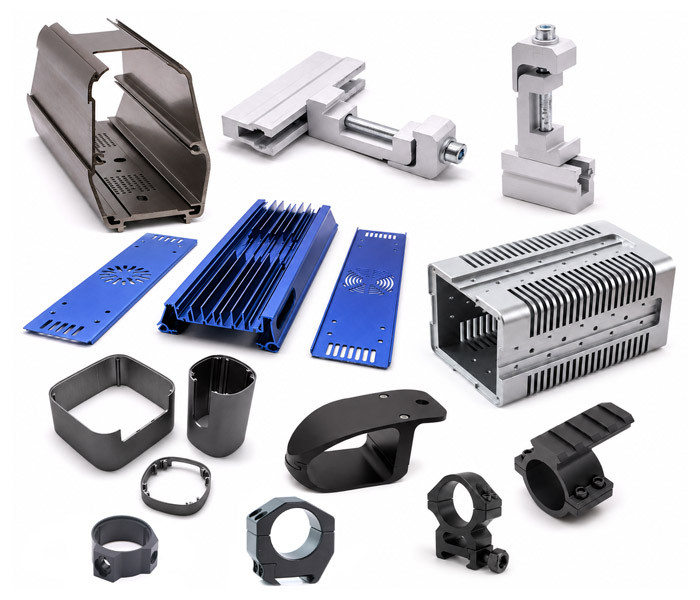
The 6xxx family is widely used for aluminum extrusions because it combines extrusion capability, heat treatability, corrosion resistance and useful structural properties. The Aluminum Association identifies 6xxx alloys as important extrusion materials for architectural and structural applications.
For CNC machined extrusion projects, material selection commonly includes:
6063 Aluminum
6063 aluminum is a useful starting point when extrusion capability, appearance and surface finish are important. AEC specifically identifies 6063 as suitable for many lower-strength and appearance-sensitive extrusion applications.
It is often considered for housings, trim components, heat-management structures and other profiles that may later be anodized.
6061 Aluminum
6061 aluminum is commonly selected where greater structural performance and subsequent CNC machining are important.
Compared with choosing material only from a strength table, you should also consider extrusion geometry, quench response, machining allowance and finishing requirements.
6005A and 6082 Aluminum
For structural applications requiring greater strength, 6005A and 6082 aluminum may also be considered. AEC identifies 6005A, 6063 and 6082 among alloys commonly used for structural extrusion applications.
Note: The best alloy is not automatically the strongest alloy. If the extrusion is difficult to manufacture, difficult to straighten or expensive to machine, the complete part cost may increase.
For more information about material conditions, see VMT's guide to aluminum tempers.
Stretching improves the starting condition of a profile, but it does not eliminate the need for a suitable CNC machining strategy.
At VMT, engineering review focuses on how the extrusion will behave after material removal.
Fixture-Induced Deformation
Thin-wall profiles can be forced into position by excessive clamping pressure.
The CNC machine may produce accurate dimensions while the part is clamped, but those dimensions can move after the fixture is released.
Fixture support should therefore locate the part without unnecessarily forcing it into shape.
Unbalanced Material Removal
Aggressively removing material from only one side of a profile can increase movement.
For sensitive geometries, roughing and finishing sequences may be separated and stock removal distributed more carefully.
Datum Selection
A raw extrusion surface is not always the best final manufacturing datum.
Functional surfaces, hole relationships and assembly interfaces should determine the datum strategy.
Toolpath and Cutting Force
Long walls and unsupported sections are vulnerable to vibration and deflection.
Tool selection, cutting engagement, machining direction and support strategy must be matched to the geometry.
Learn more about VMT's aluminum extrusion CNC machining approach when extrusion is used as a near-net-shape blank before precision machining.
A stable extrusion is only the starting point. Finished-part quality depends on linking material, profile geometry, CNC machining, inspection and finishing.
1. Drawing and DFM Review
VMT reviews your 2D drawing and 3D model to identify:
The objective is to determine which dimensions should be controlled by extrusion and which should be finished by CNC machining.
2. Extrusion Blank Review
Before batch machining, the incoming extrusion is evaluated for geometry and machining allowance.
Profiles with excessive bow, twist or inconsistent sections can create problems that cannot be economically corrected by CNC machining alone.
3. Fixture Optimization
Fixtures are designed around the profile geometry and critical datum structure.
For thin-wall housings, support location and clamping pressure are especially important for preventing deformation.
4. Machining Sequence Control
Rough machining, finishing, hole machining and secondary operations are arranged according to the geometry and tolerance requirements of the part.
For complex parts, 3-axis, 4-axis or 5-axis CNC machining may be selected according to accessibility and setup requirements.
5. In-Process Inspection
Critical dimensions can be checked during machining rather than waiting until the entire batch is completed.
This allows process drift or deformation to be identified earlier.
6. Final Dimensional Inspection
VMT's CNC quality system includes drawing review, in-process inspection and final inspection, with CMM and other measurement equipment available according to part geometry and requirements.
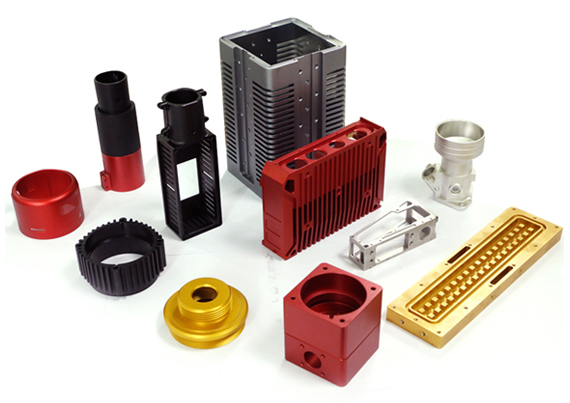
After CNC machining, aluminum extrusion components may require:
Anodizing, hard anodizing, bead blasting, sandblasting, brushing, polishing, powder coating or laser marking, depending on application and appearance requirements.
Surface finishing should be considered during DFM rather than after machining is complete.
For example, visible clamp damage on an extrusion cannot always be hidden by anodizing. Likewise, excessive burrs, deep tool marks or inconsistent blasted texture may remain visible in the finished component.
VMT coordinates CNC machining with aluminum surface finishing so that machining datums, cosmetic surfaces and final appearance requirements are considered as one process.
Tip: If your part has a Class-A cosmetic surface, mark the cosmetic zones directly on the drawing. This helps determine gripping, machining, inspection and packaging methods before production begins.
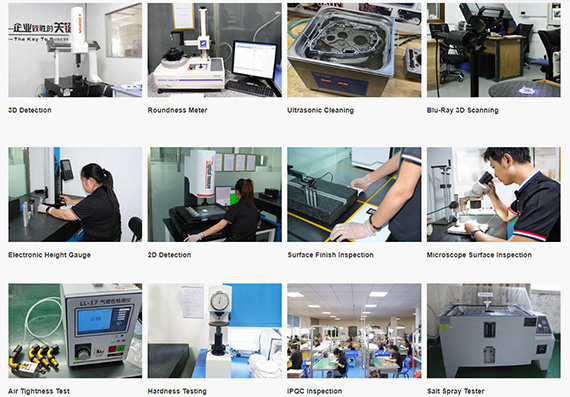
For precision projects, inspection should cover both the raw extrusion and the finished CNC part.
A typical quality plan may include:
Incoming Profile Inspection → First Article Inspection → In-Process Inspection → CMM/Dimensional Inspection → Surface Inspection → Final Inspection → Protective Packaging
Important inspection characteristics may include:
VMT describes its quality process as covering DFM review, dimensional tolerance checks, in-process inspection, final inspection and surface-finish inspection.
For batch production, this is much more reliable than checking only a few final dimensions after all machining has been completed.
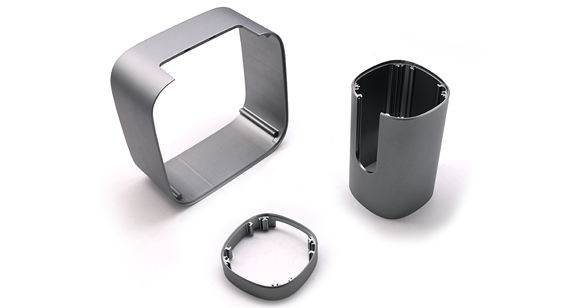
Combining an extrusion blank with precision CNC machining can be useful when your part contains a relatively constant cross-section but still requires precision holes, pockets, threads, interfaces or cosmetic finishing.
Typical applications include:
The extrusion creates the basic near-net-shape profile, while CNC machining is reserved for features where precision is actually required.
This can provide a more efficient production strategy than machining the entire component from a large solid aluminum block.
Project Background
A thin-wall aluminum equipment housing requires a relatively constant external profile together with precision holes, internal pockets and assembly interfaces.
Project Challenge
Machining the complete shape from solid stock would require extensive material removal. However, an unstable extrusion blank can bow or twist after internal material is machined away.
VMT Solution
The manufacturing plan uses an extrusion close to the required outer geometry, followed by profile-condition review, controlled fixturing, CNC roughing and finishing, critical-dimension inspection and coordinated surface finishing.
A similar extrusion + CNC strategy is used in VMT's wireless microphone housing manufacturing workflow, where the extruded shell provides the basic geometry and CNC machining creates precision functional features.
Result
The process allows extrusion to handle repeatable near-net-shape geometry while CNC machining focuses on critical functional areas, helping control machining time, dimensional risk and finishing requirements.
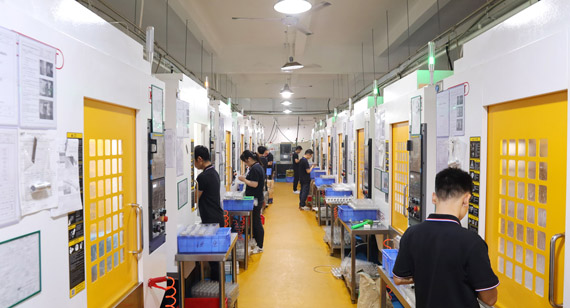
For a new extrusion-based part, going directly into a large production order creates unnecessary risk.
A better approach is:
DFM Review → Extrusion Sample → Prototype CNC Machining → Dimensional Validation → Assembly Test → Surface Finish Validation → Process Adjustment → Batch Production
Prototype validation is particularly valuable for thin walls, long profiles and appearance-sensitive products.
It allows your team to verify not just drawing dimensions but also:
Once these points are stable, the approved process can be transferred to repeat production.
A precision CNC machine cannot compensate efficiently for every problem created in an unstable extrusion blank.
For aluminum extrusion parts, dimensional consistency starts with the alloy, profile design, extrusion and quench condition, stretching and straightness control. It then continues through fixture design, machining sequence, inspection and surface finishing.
At VMT, we review the complete manufacturing process rather than treating extrusion and CNC machining as separate operations.
Have an aluminum extrusion part that still requires precision CNC machining? Upload your 2D drawing and 3D model to VMT. We can review the extrusion geometry, machining allowance, tolerances, thin-wall risks, surface finish and production strategy, then provide DFM feedback and a custom quote.
Upload Your Drawings → Request a Quote → Get DFM Feedback
Send your drawings, requirements, and target quantity. VMT will review your project and provide a machining solution and quote.
All information and uploaded files are secure and confidential.
1 Tell us what you need
2 Get solution & quote
3 Approve production
Email: inquiry@vimetal.com.cn
What is the purpose of stretching an aluminum extrusion?
Stretching is used to straighten extruded profiles and reduce internal stress and distortion. Industry guidance also recognizes stretching as a process that can influence mechanical condition, which is why modern production uses controlled recipes rather than treating it as simple manual straightening.
Is 1% the correct stretching amount for every aluminum extrusion?
No. There is no single percentage that should automatically be applied to every extrusion. The required process depends on alloy, temper route, profile cross-section, initial distortion, mechanical requirements and tolerance specification.
Does stretching completely eliminate residual stress?
No. Stretching can reduce residual stress and distortion, but finished-part stability also depends on extrusion, quenching, profile geometry, heat treatment, fixture design and CNC material removal.
What is the difference between aluminum extrusion stretching and stretch forming?
Extrusion stretching is mainly used to straighten and stabilize a profile. Stretch forming intentionally stretches and bends a profile over tooling to manufacture a curved shape.
Can CNC machining correct a badly distorted extrusion?
Some geometry can be machined into tolerance, but using CNC machining to compensate for a badly bowed or twisted blank can increase machining allowance, cycle time, fixture complexity and scrap risk. It is generally better to control the extrusion before precision machining.
Which aluminum alloys are suitable for extrusion and CNC machining?
6xxx-series alloys are widely used for extrusions. 6063, 6061, 6005A and 6082 may be selected depending on strength, extrusion geometry, surface requirements and application.
How do you inspect long CNC machined aluminum extrusion parts?
Inspection can include straightness, bow, twist, wall thickness, profile dimensions, machined datum relationships, hole position, flatness and surface condition. CMM and dedicated gauges may be used depending on the drawing and component geometry.
Can aluminum extrusion parts be anodized after CNC machining?
Yes. Many CNC machined aluminum extrusion components are anodized or hard anodized after machining. Surface preparation, machining marks, clamping areas and cosmetic requirements should be defined before finishing.


 +86 15099911516




 Read more